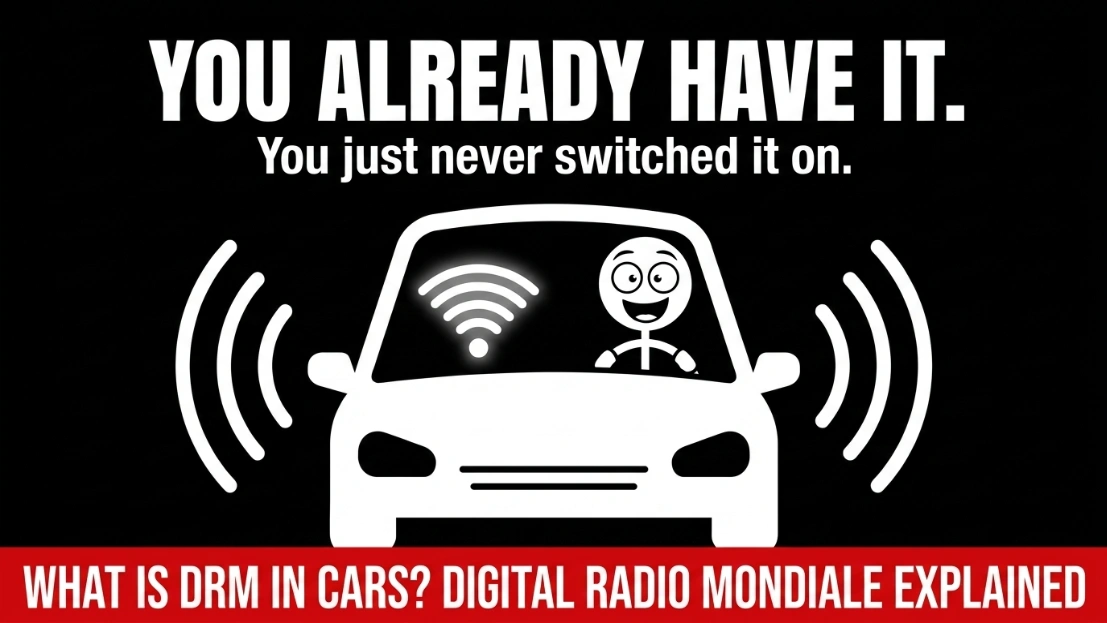
If you own a Maruti, Hyundai, Tata, or Mahindra car bought after 2017, there’s a decent chance your car already has a feature you’ve never switched on. Buried somewhere in your infotainment system is a mode called DRM. Most owners never find it. Some stumble on it by accident and then spend ten minutes searching online to understand what it means.
So, what is DRM in cars, and does it actually matter?
DRM in cars stands for Digital Radio Mondiale. It turns your car’s ordinary AM radio into something closer to FM quality. It’s free, it works without mobile data, and it’s already built into over 13 million cars on Indian roads. This guide covers what it is, how it works, which car brands have it, and how to switch it on.
Table of Contents
What Does DRM Stand For?
DRM stands for Digital Radio Mondiale. “Mondiale” is Italian and French for “worldwide”. It is a global broadcast standard, not something India-specific.
It has nothing to do with Digital Rights Management, the copy-protection technology attached to software and music. In the context of cars and radio in India, DRM in cars always means Digital Radio Mondiale. The abbreviation overlap catches a lot of people out when they search for it.
The DRM Consortium is the international non-profit body behind the standard. Its founding members included the BBC World Service, Radio France Internationale, Deutsche Welle, and Voice of America. All India Radio joined early and has since become one of the largest DRM deployments anywhere in the world.
How Does DRM Radio Work in a Car?
Regular AM radio sends an analogue signal. You get the station, but you also get hiss, static, and a signal that fades the moment you drive through a valley or under a bridge. DRM in cars fixes this by digitising the same AM frequencies.
The frequency stays the same. Instead of a raw analogue wave, the transmitter sends a compressed digital stream. Your car’s receiver decodes that stream using xHE-AAC, the same kind of audio codec used in modern streaming apps. The result is audio that sounds closer to FM, sometimes better, on a band that covers hundreds of kilometres from a single transmitter.
The signal uses a method called COFDM (Coded Orthogonal Frequency Division Multiplexing), which resists interference and multipath fading well. On a long highway drive through rural Rajasthan or central Maharashtra, a regular AM station crackles and fades constantly. A DRM broadcast on the same frequency stays clean.
There is also a data layer. DRM carries text alongside audio: news headlines, song titles, programme information in multiple languages. This shows up on your head unit’s display, similar to RDS metadata on FM.
What Frequencies Does DRM Use in India?
All India Radio broadcasts DRM on medium wave (MW) and shortwave (SW) bands, the same frequency ranges as traditional AM radio, between roughly 500 kHz and 26 MHz.
The technical names: DRM30 covers frequencies below 30 MHz (MW and SW included), and DRM+ covers VHF bands including the FM range at 88-108 MHz. India is on DRM30 right now. FM band DRM is in active testing, and TRAI recommended DRM as India’s national FM digitisation standard in late 2025. If that goes ahead, most existing DRM car receivers could be updated by software to receive digital FM too.
DRM vs FM vs AM: What’s the Difference?
| AM (Analogue) | FM (Analogue) | DRM | |
|---|---|---|---|
| Sound quality | Poor, noisy | Good | Near-FM or better |
| Coverage area | Very large | Limited to urban | Very large |
| Data features | None | Basic RDS | Rich text, news, multilingual |
| Interference | High | Moderate | Very low |
| Needs internet? | No | No | No |
FM is better than AM in cities, but loses signal fast in rural areas. AM covers huge distances but sounds rough. DRM in cars gets you AM’s reach with FM’s audio clarity. That’s the core promise, and it mostly delivers.
Which Cars in India Have DRM Radio?
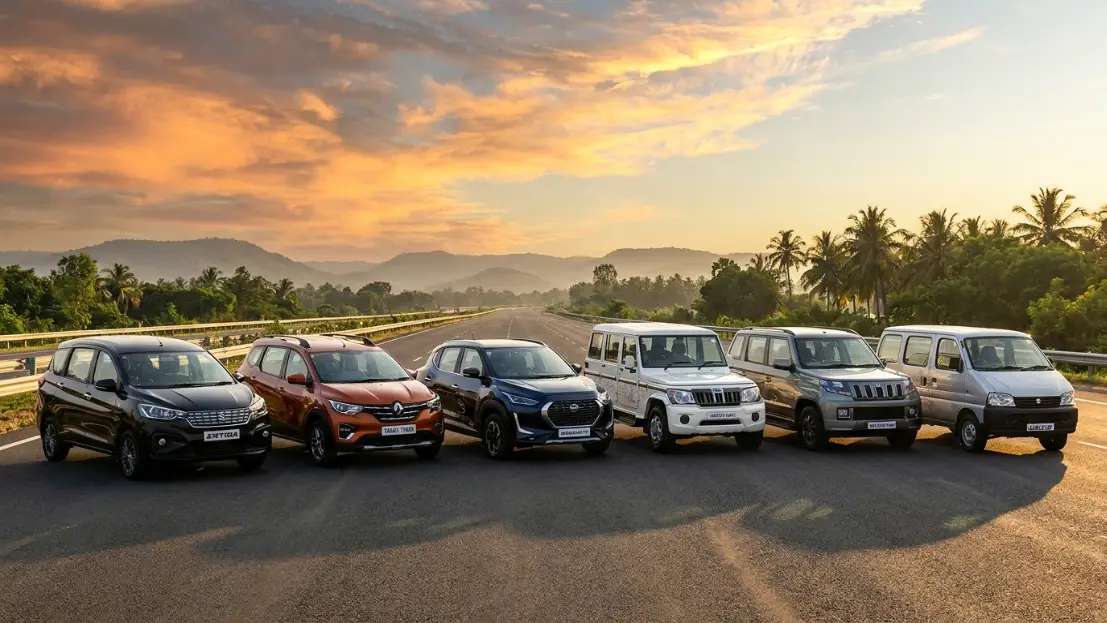
This is the question most people actually want answered. The following car brands have included DRM radio in their Indian models from 2017 onwards, at no extra charge to the buyer:
- Maruti Suzuki: Swift, Baleno, Vitara Brezza, Ertiga, Dzire, and most other models
- Hyundai: Creta, i20, Venue, Verna, and nearly all other models
- Tata Motors: Nexon, Harrier, Tiago, Tigor, Altroz
- Mahindra: XUV series, Scorpio N, Bolero Neo
- Toyota: Fortuner, Innova Crysta, Urban Cruiser Hyryder
- MG Motor: Hector, Astor, Gloster
- Mercedes-Benz: select India-market models
As of early 2026, over 13.2 million cars on Indian roads carry DRM receivers. That’s about 30% of all passenger vehicles sold in India. The UK has been deploying DAB digital radio for over 20 years and hasn’t reached comparable automotive penetration.
The speed of India’s adoption comes down to one decision: car manufacturers included DRM as a default feature rather than a paid upgrade. No one paid extra. The receivers went into infotainment systems from the start, before AIR had even launched its full DRM service. The car industry built the audience before the broadcaster finished setting up the transmitters.
How to Check If Your Car Has DRM
Open the radio or tuner app on your infotainment screen and look for:
- A mode labelled “DRM” in the tuner or settings menu
- A “Digital Radio” or “DAB/DRM” option
- An AM mode that shows text data on the screen when tuned to an AIR frequency
Many head units have this feature two or three menus deep. If your car is a 2018 or newer model from Maruti, Hyundai, or Mahindra, it almost certainly has DRM built in. Team-BHP’s DRM forum thread has model-specific instructions from owners who’ve already tracked it down.
How to Activate DRM Radio in Your Car
- Go to the radio or tuner menu on your infotainment screen
- Look for “Source” or “Mode” and switch from FM to AM, or look for a DRM option directly
- On some head units, pressing and holding the AM button reveals digital modes
- Once in DRM mode, scan or manually tune to All India Radio’s MW frequencies for your region (check AIR’s website)
- When the signal locks, the programme name and text data will appear on screen
Coverage is patchy in some parts of the country. AIR has over 35 DRM transmitters across India, but signal strength varies by location and transmitter power. Highway and rural coverage is generally better than in city centres, where building density creates multipath interference on MW.
What Can You Listen to on DRM Radio in India?
The main broadcaster right now is All India Radio (Akashvani). On DRM radio in cars, AIR offers:
- News in multiple languages
- AIR News 24/7, a DRM-only channel not available on analogue AM
- Live cricket commentary
- Regional programming with on-screen text in local languages
It’s all free to air. No subscription, no app, no data needed. The signal comes from AIR’s transmitters to your car’s antenna, the same way regular radio has always worked.
Why DRM Radio Works Well on Long Drives
This part matters for anyone who drives between cities often. Long drives in India routinely pass through zones with no mobile signal, weak FM coverage, and AM stations barely cutting through the noise. DRM radio in cars practically addresses this.
Medium wave propagates over long distances. A single 1000 kW DRM transmitter can cover a large geographic area. AIR has transmitters at that power level at several sites across India. The digital encoding means the signal doesn’t slowly degrade into static as you move away from the transmitter. It holds until it can’t hold anymore, then drops. No gradual fade, no 100-kilometre hiss. Either it’s working, or it isn’t.
That hard cutoff is occasionally jarring, but for most of a long drive, it means consistent audio where analogue AM would have been unlistenable.
India’s Role in DRM’s Survival
India is the main reason DRM radio in cars exists as a live, growing technology in 2026. The consortium spent years trying to get manufacturers and broadcasters in other countries to commit. The UK chose DAB. The US chose HD Radio. Most countries chose nothing and stayed analogue.
India chose DRM, and the car industry came with it. The combination of AIR’s transmitter investments and the automotive sector building DRM into every new car by default created the feedback loop the technology needed. By the time 5 million DRM-equipped cars were on Indian roads, it was a self-sustaining market.
The chipsets and receivers inside those 13 million cars were developed by NXP Semiconductors and Inntot Technologies, the latter based in India. This is a domestic technology story that rarely gets the attention it deserves.
What’s Coming Next: DRM on the FM Band
The next phase is FM digitisation. TRAI’s October 2025 recommendation named DRM as India’s national standard for the FM band (88-108 MHz). If implemented, India’s 500+ FM stations could broadcast in DRM+ alongside or instead of analogue FM.
For existing car owners, most DRM-equipped cars already have the hardware needed to receive DRM+ on FM frequencies. The receiver can handle it. It needs a firmware update, not a hardware replacement. Owners of those 13 million DRM-capable cars could potentially receive FM digital radio without changing anything in their vehicles.
DRM would then be the only digital radio standard covering all broadcast bands (SW, MW, and FM) from one receiver. No other standard does that.
In Summary
What is DRM in cars? It’s a free digital radio system built into millions of Indian vehicles that most owners have never switched on. It runs on AIR’s medium wave network, delivers better audio than analogue AM, works without an internet connection, and covers the kind of long highway distances where FM signal simply is not there.
If your car is a 2018 or newer model from Maruti, Hyundai, Tata, Mahindra, or Toyota, it’s worth five minutes in your infotainment settings to find the DRM option. You might have a working radio feature you never knew existed.
It’s not flashy. It won’t appear in a spec sheet. But on a six-hour drive where your phone has no signal and every FM station dropped out two hours ago, DRM in cars is the one thing still playing clearly.
FAQs on What is DRM in Cars
Is DRM radio free in India?
Yes. All India Radio’s DRM broadcasts are free to air, with no subscription, data, or app needed.
Which Maruti Suzuki models have DRM?
Most Maruti models produced from 2017 onwards, including the Swift, Baleno, Vitara Brezza, Ertiga, and Dzire. Check your infotainment’s tuner settings for a DRM or Digital Radio mode.
Can I add DRM to an older car?
Aftermarket options exist but are limited. Elements Innovation makes a multi-standard unit that includes DRM. For some 2017-2020 cars with compatible head units, a software update from the manufacturer may already enable the feature.
What’s the difference between DRM and DAB radio?
DAB works only on VHF Band III, which limits it to urban areas. DRM works on SW, MW, and FM, which suits India’s geography much better. DAB is the UK and European standard.
Does DRM radio in cars use mobile data?
No. DRM is a terrestrial broadcast standard. It uses radio transmitters and your car’s antenna, with no internet connection involved.
What is DRM Emergency Warning Functionality?
It’s a feature built into the DRM standard that interrupts regular programming and wakes receivers in standby mode to broadcast emergency alerts. Built for floods, natural disasters, and other crises. The hardware is already in your car’s DRM receiver.
Why can’t I find DRM stations in my city?
AIR’s current DRM service is on MW and SW bands. FM band DRM is not yet live in most cities. MW coverage is stronger on highways and in rural areas than in dense urban zones.
Is DRM in cars the same as Digital Rights Management?
No. What is DRM in cars means Digital Radio Mondiale, a broadcast standard. Digital Rights Management is a completely separate technology used for content copy-protection. Same abbreviation, two different things.