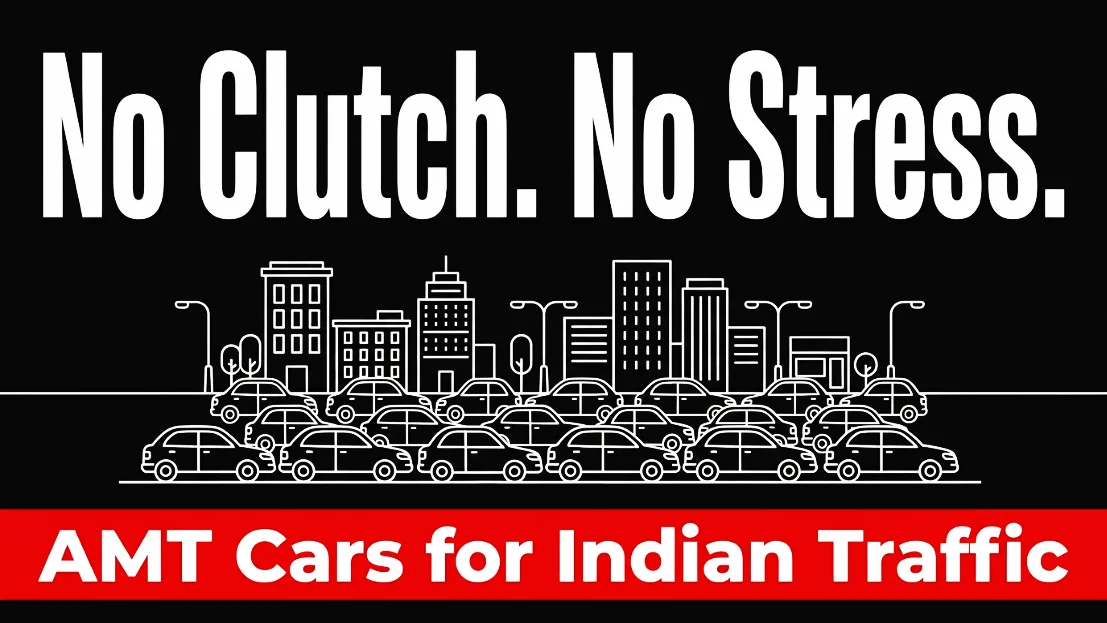
It’s Monday morning in Bangalore. Hosur Road. You’re on the clutch every few seconds, the car inches forward, your left knee is already complaining, and you’ve covered maybe two kilometres in twenty minutes.
This is not a unique experience. It’s a daily ritual for millions of Indian commuters, and it’s probably the single biggest reason AMT gearboxes have sold so well here over the past decade. The AMT gearbox gave India’s budget car buyers something that didn’t exist before 2014: automatic driving ease at manual car prices.
If you’re trying to figure out what is AMT gearbox, whether it’s worth buying, and what the real-world trade-offs look like. This guide covers it all.
Table of Contents
What is AMT? Full Form and Simple Definition
The AMT gearbox (short for Automated Manual Transmission) is a standard manual gearbox, the same mechanical setup you’d find in any stick-shift car, with electronic and hydraulic actuators that handle the clutch and gear changes automatically. No clutch pedal. No gear lever to move. The car shifts on its own, based on your speed, engine RPM, and throttle input.
Here’s where a lot of buyers get confused: AMT is classified as an automatic transmission, even though the gearbox inside is mechanical and manual. When you’re comparing cars, it will appear on the spec sheet as “automatic.”
AMT vs a regular automatic: what’s the actual difference?
A conventional automatic (torque converter, CVT) uses a completely different internal design: fluid couplings, planetary gears, or metal belt-and-pulley systems. AMT keeps the standard manual gearbox and adds a computer-controlled layer to operate the clutch and shifter. The result is the fuel efficiency and simplicity of a manual transmission, without you having to do any of the manual work.
How Does an AMT Gearbox Work?
Three components get added to a standard manual gearbox to create an AMT gearbox system:
1. Sensors The system reads vehicle speed, engine RPM, throttle position, and road gradient continuously. This data feeds into the control unit in real time.
2. Transmission Control Unit (TCU) This is the brain of the system. The TCU reads the sensor data and decides when to shift up or down and how aggressively to engage the clutch.
3. Electro-hydraulic Actuators These physically move the clutch and gear selector, doing the same job your left foot and right hand do in a manual car, but handled mechanically.
When you pull away from a traffic light, the TCU tells the actuators to ease the clutch in gradually, then shifts to second once the RPM hits the right range, then third, and so on. When you back off the throttle, the system reads this and prepares for a downshift.
The key components of an AMT gearbox:
- The base manual gearbox (5-speed or 6-speed, same as standard)
- Actuators for clutch operation and gear selection
- Speed and RPM sensors
- TCU/ECU (the control unit running the shift logic)
The Maruti Suzuki Celerio was the first mass-market AMT car in India, launched in 2014. The early system was basic. Shifts felt rough, and the tech wasn’t fully sorted. Today’s AMT systems, particularly Hyundai’s, are considerably better calibrated.
Why Did the AMT Gearbox Take Off in India?
AMT found a problem that genuinely needed solving in the Indian market.
Traffic that breaks your left leg: Delhi, Mumbai, Bangalore, Chennai. The kind of traffic in these cities isn’t just slow, it’s mentally exhausting. Constant clutch work in stop-and-go conditions causes real leg fatigue, and for some people with knee or ankle issues, it’s a daily inconvenience. AMT removes the clutch pedal entirely.
The price gap that mattered: An AMT variant costs roughly ₹30,000–50,000 more than the manual version of the same car. A CVT or torque converter automatic adds ₹80,000–1.5 lakh. In the under-₹10 lakh segment, that difference is significant.
Fuel efficiency that doesn’t take a big hit: Unlike a torque converter or CVT, AMT uses the same gear ratios as the manual car. So you’re not giving up much in fuel economy. Many AMT cars (WagonR AMT, Tiago AMT) return over 20 kmpl in city driving.
Straightforward to maintain: The mechanical gearbox is a standard manual unit. Spare parts are cheap and widely available. Any mechanic who knows manual transmissions can work on the mechanical side.
Easier for drivers switching from manual: More than 90% of Indian drivers learn in a manual car. Jumping to a full automatic can feel strange at first. AMT is an easier transition. It behaves like an automatic, but the driving experience has a familiar feel to it.
The Creep Function
Worth a separate mention: when you lift your foot off the brake in an AMT car, it moves slowly forward without pressing the accelerator, the same way a torque converter automatic does. This is called the creep function, and it’s more useful than it sounds. Tollbooths, tight parking, bumper-to-bumper crawl, and the car moves itself so you don’t have to constantly tap the accelerator.
Advantages of AMT Gearbox
No clutch fatigue in city traffic: The main reason to buy one. Stop-and-go driving stops wearing you out when there’s no clutch pedal to operate.
Fuel economy close to manual: AMT mileage usually lands within 5–10% of the manual variant. In city conditions, where clutch slipping reduces efficiency on manual cars, AMT sometimes edges ahead.
Lower purchase price than other automatics: The Maruti Alto K10 AMT starts at around ₹5.5 lakh, the cheapest automatic car in India. That price point doesn’t exist for CVT or torque converter options.
Low maintenance costs: The AMT gearbox base unit is a standard manual gearbox. Service costs are low, parts are easy to find, and there’s no periodic ATF change required (unlike CVT or torque converter cars).
Hill hold assist: Most current AMT cars hold the car stationary on a slope for 1–2 seconds after you lift the brake. This gives you time to press the accelerator before the car starts to roll back. It mostly solves the old AMT-on-inclines problem.
Manual override: Most AMT cars let you take control and shift manually using the gear lever in sequential mode, or paddle shifters where available. The Renault Kwid is an exception. It doesn’t offer manual override.
Disadvantages of AMT Gearbox
AMT has real drawbacks. Worth knowing them before you buy.
Jerky shifts at low speeds: The most common complaint. When the car changes from first to second at low speed, there’s a brief interruption in power delivery. Passengers feel it as a slight lurch, sometimes called the “head nod.” Older AMT systems were noticeably bad for this. Newer ones are better, but it hasn’t gone away entirely. Hyundai’s AMT calibration is generally the best in the budget segment on this front.
Lag during hard acceleration: Floor the accelerator for a sudden overtake, and there’s a brief delay before the system catches up and the power arrives. Not a problem in normal driving, but worth knowing if you regularly need quick bursts of speed.
Not the best for steep hills or spirited driving: AMT works fine on hills, especially with hill hold assist. But on very steep, winding terrain with constant gear changes, a torque converter or even a manual will feel more responsive.
Cannot be push-started: The ECU and actuators need battery power to operate. A dead battery means you need a jump-start, not a push.
It’s not a true automatic: AMT has its own character. Buyers expecting the silky smoothness of a torque converter or CVT will find AMT underwhelming. It’s a different thing, not a lesser version of those.
Also Read: How to Improve Car Mileage in India: 12 Proven Tips that Actually Work
AMT vs Other Gearboxes
| Feature | AMT | Manual | Torque Converter (AT) | CVT | DCT |
|---|---|---|---|---|---|
| Clutch pedal | No | Yes | No | No | No |
| Fuel efficiency | High | Highest | Medium | Medium | High |
| Shift smoothness | Moderate | Driver-dependent | Excellent | Excellent | Very high |
| Purchase cost | Low | Lowest | High | High | High |
| Maintenance cost | Low | Lowest | Medium | Medium | High |
| Best for | City commute | Enthusiasts/highways | Premium city use | Highway comfort | Performance |
AMT vs CVT
CVT uses a metal belt and pulleys to deliver seamless, stepless acceleration with no discernible gear shifts at all. The driving experience is smooth and quiet. The downsides: CVT units cost more to buy and repair, and some drivers find the “rubber band” feel during hard acceleration frustrating. AMT is cheaper and more efficient. CVT is smoother. Pick based on what matters more.
AMT vs Torque Converter (AT)
Torque converter automatics are the most comfortable option. Gear shifts are seamless, slow-speed behaviour is good, and there’s no head nod. They’re heavier, more expensive, and burn slightly more fuel. If budget isn’t a constraint and daily city comfort is the priority, torque converter wins. If you’re working with a ₹5–10 lakh budget, AMT is probably your only realistic automatic option.
AMT vs DCT
DCT uses two separate clutches (one for odd gears, one for even), which allows very fast, precise shifts. It’s the performance choice. But dry-clutch DCTs from some manufacturers have had reliability issues in Indian stop-and-go traffic, and servicing is expensive. AMT is a much easier ownership proposition. DCT makes sense if you’re in the performance car segment; AMT is for practical everyday use.
Popular AMT Cars in India (2026)
Maruti Suzuki has the widest AMT range in India. Alto K10, Celerio, WagonR, Swift, Dzire are all available with AMT. Maruti was the brand that brought AMT to India, and their systems are well-sorted. The Swift AMT returns around 25.75 kmpl, making it one of the most fuel-efficient AMT cars on sale.
Hyundai offers AMT on the Grand i10 NIOS, Aura, and Exter. Their AMT calibration is the smoothest in the budget segment. The head nod is noticeably reduced compared to competitors.
Tata Motors has AMT on the Tiago, Tigor, and Punch. The Punch AMT is one of the few AMT cars available with factory-fitted CNG, a combination that’s hard to find elsewhere.
Renault has AMT on the Kwid and Triber. The Kwid AMT is the exception that doesn’t allow manual override.
Nissan Magnite comes with AMT on select lower trims.
Cheapest AMT car in India: Maruti Alto K10, approximately ₹5.5 lakh ex-showroom.
AMT Gearbox Mileage in India: What to Expect
The worry that switching from manual to AMT will tank your fuel economy is mostly overstated.
AMT uses the same gear ratios as the manual version of the same car, so efficiency figures are close. In city driving specifically, where human drivers tend to slip the clutch a lot, the TCU’s precise clutch engagement can actually improve mileage compared to the manual.
Some real-world city figures from common AMT models:
- WagonR AMT: 20–22 kmpl
- Tiago AMT: 19–21 kmpl
- Celerio AMT: 22–24 kmpl
- Swift AMT: 22–25 kmpl (combined)
Aggressive driving and hard braking will drop these numbers. The AMT gearbox rewards steady, calm driving.
AMT Maintenance: What It Costs and How to Drive One Properly
Maintenance costs for AMT cars are low. The base gearbox is a standard manual unit. Oil changes, clutch inspection, and gear servicing are cheap and available anywhere. There’s no ATF fluid to replace on schedule (unlike CVT or AT cars). With normal use, a clutch can last over 1 lakh km.
Five habits that protect your AMT gearbox:
- Don’t switch between Drive and Reverse while the car is still moving, as this stresses the actuators.
- Shift to Neutral during long stops (signals over 30 seconds). Sitting in Drive with your foot on the brake holds the clutch partially engaged.
- Unlearn the left-foot-on-brake habit. Almost everyone who learned on a manual does this at first in an AMT car. It causes hard, sudden stops.
- Plan overtakes a second in advance. There’s a brief lag between your foot pressing down and the power actually arriving. Build speed before committing to the pass.
- Use hill hold assist on slopes, not the accelerator-clutch balance technique some manual drivers try.
Who Should Buy an AMT Car in India?
AMT makes sense for:
- Daily commuters in congested city traffic who’ve had enough of clutch work
- First-time car buyers on a budget who want automatic ease without paying ₹12–15 lakh
- Drivers with knee or ankle issues who find clutch use uncomfortable
- Anyone shopping in the ₹5–10 lakh range, where CVT and AT options are scarce
It’s less suitable for:
- Drivers who spend most of their time on highways and want a smoother, more refined ride
- People who enjoy driving and want precise, quick gear changes
- Frequent hill driving where transmission responsiveness matters more
Conclusion
The AMT gearbox became the default automatic choice for budget Indian car buyers because it addressed a real, specific problem: grinding city traffic on a budget. It’s not the most refined transmission on the market. The head nod is real. The lag during hard acceleration is real. But for someone spending 45 minutes a day in Kozhikode or Pune traffic, removing the clutch pedal changes the experience in a way that’s immediately noticeable.
Understand what the AMT gearbox actually is (an automated manual, not a conventional automatic), and it makes total sense. Set the right expectations, and you won’t be disappointed. If your daily reality is bumper-to-bumper commutes and your budget is under ₹10 lakh, AMT is probably the most sensible thing you can put in your garage.
FAQs on What is AMT Gearbox
Is AMT suitable for highway driving?
It works, but the shift lag is more noticeable at highway speeds. For long highway trips, a torque converter or CVT feels more polished.
Can I manually shift gears in an AMT car?
Most AMT cars have a sequential manual mode. The Renault Kwid AMT is a notable exception. It doesn’t offer manual gear control.
How long does an AMT gearbox last?
With normal driving and regular servicing, an AMT gearbox lasts well over 1 lakh km. The clutch plate will eventually need replacement, same as any manual car.
Is AMT better than a torque converter for Indian roads?
For buyers on a tight budget in heavy city traffic, AMT is the practical choice. If you want smooth, effortless shifts and aren’t constrained by price, a torque converter is the better driving experience.
What is the cheapest AMT car in India in 2025?
Maruti Suzuki Alto K10 AMT, at approximately ₹5.5 lakh ex-showroom.
Can an AMT car be push-started?
No. The system needs battery power to run the ECU and actuators.
Does AMT reduce fuel efficiency?
Not much. AMT mileage is usually within 5–10% of the manual variant, and in city traffic, it can actually be slightly better.
Is AMT good for hilly areas?
Hill hold assist handles most situations well. For very steep, technical terrain with frequent gear changes, a manual or torque converter gives more confident control.