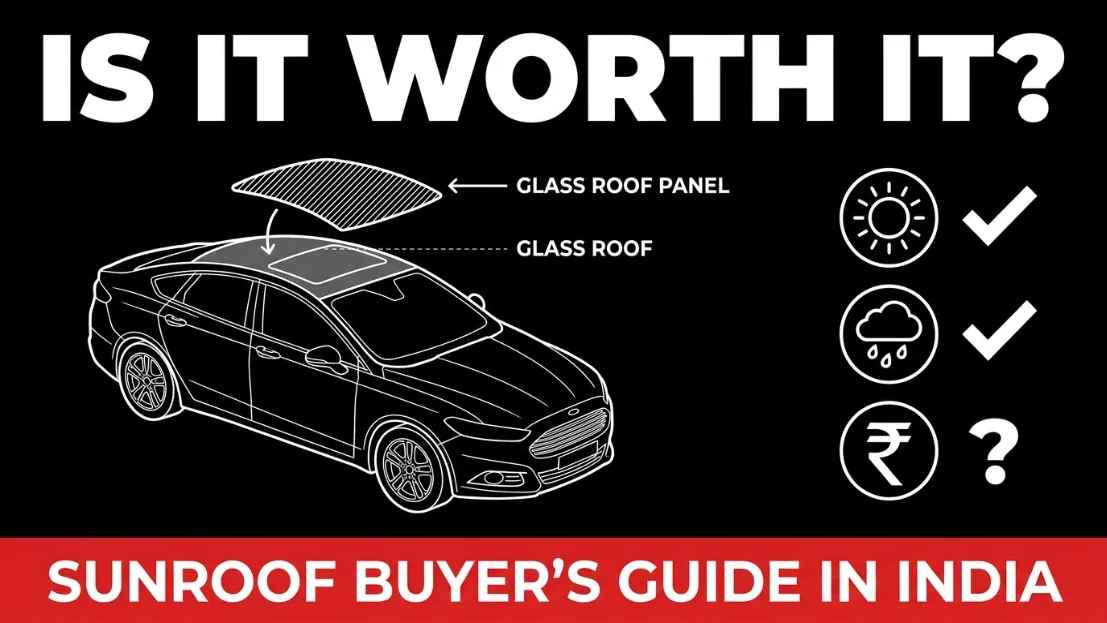
You’ve just parked your car under the afternoon sun for 45 minutes. You open the door, and it hits you like a wall of heat. The steering wheel is untouchable. The seat burns through your clothes.
Now imagine hitting a button, letting the cabin breathe for a minute, and stepping into something that actually feels like a car rather than a tandoor.
That’s one of the simplest arguments for What is the Use of Sunroof in Car?, and also one of the most practical in India.
Sunroofs used to be a luxury-only thing. BMW, Mercedes, Audi. If your car had one in the early 2000s, you were either rich or renting. Today, you’ll find them on cars that cost less than Rs 8 lakh. The Tata Nexon, Maruti Fronx, Hyundai Venue, and MG Astor all offer it now.
So what does a sunroof actually do? Is it useful, or just something that makes for a good Instagram shot in a hill station?
Table of Contents
What is a Sunroof in a Car?
A sunroof is an opening in a car’s roof, usually glass or metal, that lets in light, air, or both.
The word “sunroof” has become a catch-all term. Technically, an older-style sunroof was a solid opaque panel you could slide or pop open. A moonroof, which came later, is glass, so it lets natural light into the cabin even when completely closed.
Most people (and most car brochures) use both terms interchangeably. When a salesperson says “this car has a sunroof,” they almost certainly mean a glass panel that tilts, slides, or both. The moonroof is the current standard.
Sunroof vs moonroof: what’s the difference?
| Feature | Sunroof | Moonroof |
|---|---|---|
| Material | Opaque (metal/canvas) | Transparent glass |
| Light when closed | No | Yes |
| Operation | Manual or electric | Mostly electric |
| Common today? | Rare (older cars) | Yes, standard |
If your car has a glass panel above you, whether it opens or not, that’s technically a moonroof. Call it a sunroof, and nobody will correct you.
What is the Use of a Sunroof? Every Day, Practical Uses
Better ventilation without the windblast
Open windows at 80 km/h are loud, turbulent, and do strange things to your hair. A tilted sunroof pulls air through the cabin much more calmly. You get airflow without the noise and without the drag that comes from opening all four windows.
For anyone driving on highways regularly, this is a real difference.
Getting hot air out of a parked car
When you park in the sun and get back in, the fastest way to cool the cabin is to open the sunroof fully for a minute while the AC kicks in. Hot air rises, and the sunroof gives it somewhere to go. It cuts down the time your AC needs to make the cabin bearable.
In places like Kerala, Tamil Nadu, or Delhi in May, this stops being a nice-to-have and becomes a sanity-saver.
Reducing interior fog in the monsoon and winter
Slightly cracking the sunroof in cold or rainy weather clears the fogging on your windshield faster than running the defogger alone. It creates a small pressure difference that pushes moist air out. Useful during Kerala monsoons or on misty hill roads.
Long drives, hill stations, night skies
Driving through Munnar, Coorg, Spiti, or even Lonavala with the sunroof open is a different experience. The smell of the trees, the cooler air, and stars when you’re parked. It’s not the most practical use on this list, but it’s the kind of thing that makes you glad you have it.
Key Benefits of a Sunroof
Having a sunroof changes the feel of the cabin in a few consistent ways.
The car feels bigger. Glass overhead removes the visual ceiling, and even a compact hatchback feels less cramped when there’s sky above you. It’s one of those things that’s hard to explain until you’ve driven one.
Natural light reduces driver fatigue on long drives. Not dramatically, but measurably. The AC-recycled air in a sealed cabin gets stale after 3 or 4 hours, and even a partially open sunroof changes that.
The premium-feel argument is real, and car manufacturers know it. A sunroof in a Rs 9 lakh car makes the cabin feel more expensive than it is. That’s partly why manufacturers started offering it lower down the model range.
On resale, sunroof variants consistently sell faster and at a small premium in India’s used car market. Nothing dramatic, but if you’re thinking about reselling in 5 years, it counts.
Types of Sunroof in Cars
Not all sunroofs work the same way. Here is what’s actually available in the Indian market.
A regular sliding sunroof is a single glass panel that tilts up at the back or slides open over the roof. It is the most common type, electrically operated in most new cars. This is what the Nexon, Creta, Venue and most mid-range cars offer.
A spoiler sunroof tilts and slides slightly above the roofline rather than retracting under the roof. It lets air in without a full opening.
A panoramic sunroof is a larger glass area that spans both front and rear passengers. Some open partially, some are fixed. The MG Hector, Tata Harrier, and Hyundai Tucson use these. They look great. They also let in more heat if the glass is not UV-rated.
A solar sunroof has photovoltaic cells embedded in the glass that power the cabin ventilation fan. Toyota used this in some Prius variants. Not widely available in India yet, but growing with the EV market.
A folding or fabric sunroof is the classic rag-top on older convertible-style cars. Rare in modern India. The original VW Beetle had one.
Removable roof panels (T-tops, as on the Jeep Wrangler) are panels that come out fully and must be stored elsewhere. Not technically a sunroof, but they do the same job.
For most Indian buyers, the choice comes down to regular sliding or panoramic. If rear passengers care about headroom, a panoramic roof actually takes up less vertical space than a standard sunroof with its motor and housing.
Disadvantages of Sunroof in Cars
There are real trade-offs worth knowing before you pay for the variant.
- Reduced headroom is the most common complaint. The motor, rails, and housing for an electric sunroof take up about 2 to 3 cm of cabin height. Not a problem for average-height passengers, but if you’re 6 feet or taller, you’ll feel it in compact cars.
- Leaks are the other big issue. The seals around a sunroof deteriorate over time, especially with India’s temperature extremes and monsoon rains. A clogged drain channel or worn seal means water inside your car. It’s preventable with basic maintenance, but it does need maintenance.
- Heat gain with the wrong glass is a third one. A panoramic roof made of regular glass turns your car into a greenhouse. This matters more in India than in most climates. Not every car or aftermarket installation uses UV and IR-rated glass, so it’s worth checking before you buy.
- An open sunroof at highway speeds creates drag, which nudges fuel consumption up slightly. Closing it on long highway stretches is the sensible call.
- And a sunroof assembly adds around 5 to 10 kg to the roof, which slightly raises the center of gravity. Unlikely to matter in normal driving, but it exists.
Is a sunroof worth it in India?
It depends on how and where you drive.
If you mostly drive in city traffic in Bangalore or Hyderabad, with the AC on and the sunroof closed most of the year because it’s either scorching or raining, then the sunroof sits there looking good but not doing much. You’re paying Rs 30,000 to Rs 80,000 extra for a feature you use on weekends.
If you do hill station trips, long highway drives, or early morning commutes in cooler weather, you’ll use it regularly and probably not regret it.
The one thing that changes the equation entirely is glass quality. A panoramic roof with poor UV protection in Chennai or Delhi will make your cabin hotter, fade your dashboard faster, and make your AC work harder. If the car you’re looking at has a panoramic roof, ask specifically about the glass: UV protection, IR rejection, and whether it includes a sunshade.
Sunroof Maintenance: What You Actually Need To Do
It’s not complicated, but skipping it will cost you eventually.
Clean the tracks and seals every 3 or 4 months. Dust, leaves, and road grime collect in the rail and seal groove. A soft brush and mild cleaner keep these clear. A clogged track causes the motor to strain or the panel to get stuck.
Check and clear the drain channels before and during the monsoon. Every sunroof has small drain holes at the corners that channel water away from the cabin. In India, these get clogged with leaf debris and dust. Pour a little water when the sunroof is closed; it should drain cleanly from under the door sills. If water backs up into the cabin, the drain is blocked.
Lubricate the moving parts once a year. Silicone spray on the rails and hinges keeps the mechanism running smoothly. Do not use WD-40 on rubber seals, as it dries them out.
Inspect the seals before the monsoon. Cracked or hardened weatherstripping is the most common cause of sunroof leaks. It’s cheap to replace when you catch it early, and much less cheap after the water damage.
If the sunroof feels slow or resistant, stop and investigate before forcing it. Forcing it will strip the motor gears or bend the tracks.
The bottom line
A sunroof won’t make you a better driver, and it won’t save you money on fuel. But it fixes something real: the sealed, recirculated-air stuffiness of a fully closed cabin on a long drive.
For Indian conditions, the use case holds up. Faster cabin cooling after parking in the sun, better hill station drives, and monsoon fog that clears faster. Not life-changing, but more useful than people expect before they own one.
If you’re choosing between variants, go for the one with UV and IR-rated glass. A panoramic roof with regular glass is an oven with a view. Get the glass right, maintain the seals before the monsoon, and it won’t give you trouble.
Also Read: How to Stop Your Car From Fogging Up: Quick Fixes and Long-term Prevention
FAQs on What is the Use of Sunroof in Car
Does a sunroof reduce headroom?
Yes, by about 2 to 3 cm in most cars. Usually not noticeable for average-height passengers, but taller drivers (6 feet and above) may feel it in compact cars.
Can I open the sunroof in rain?
Tilt mode only. It vents air while the angle deflects rain. Fully opening it in the rain will get the cabin wet and can push water into the drain system faster than it clears.
Which cars under Rs 10 lakh have a sunroof in India?
As of 2025, options include the Tata Nexon, Maruti Fronx, Hyundai Venue, and Kia Sonet in select variants. The variant with a sunroof varies by model, so check the trim list carefully before booking.
Does a sunroof increase resale value?
Generally, yes, in India. Sunroof variants of popular models like the Creta or Nexon sell faster and at a slight premium in the used car market.
What is a panoramic sunroof?
A larger glass roof that spans both front and rear seating areas, either as one large panel or two sections. It lets in more light and gives a more open feel, but it needs UV-rated glass or the cabin heats up fast.
Is a solar sunroof available in India?
Not widely yet. Solar roof options exist on some Toyota hybrids globally and a few EV concepts. It’s expected to grow with India’s EV market since the panel powers cabin ventilation rather than the drive motor.
What’s the difference between a sunroof and a moonroof?
A sunroof is technically an opaque panel; a moonroof is transparent glass. In practice, almost every car sold today has the glass version. If it lets light through when closed, it’s a moonroof.