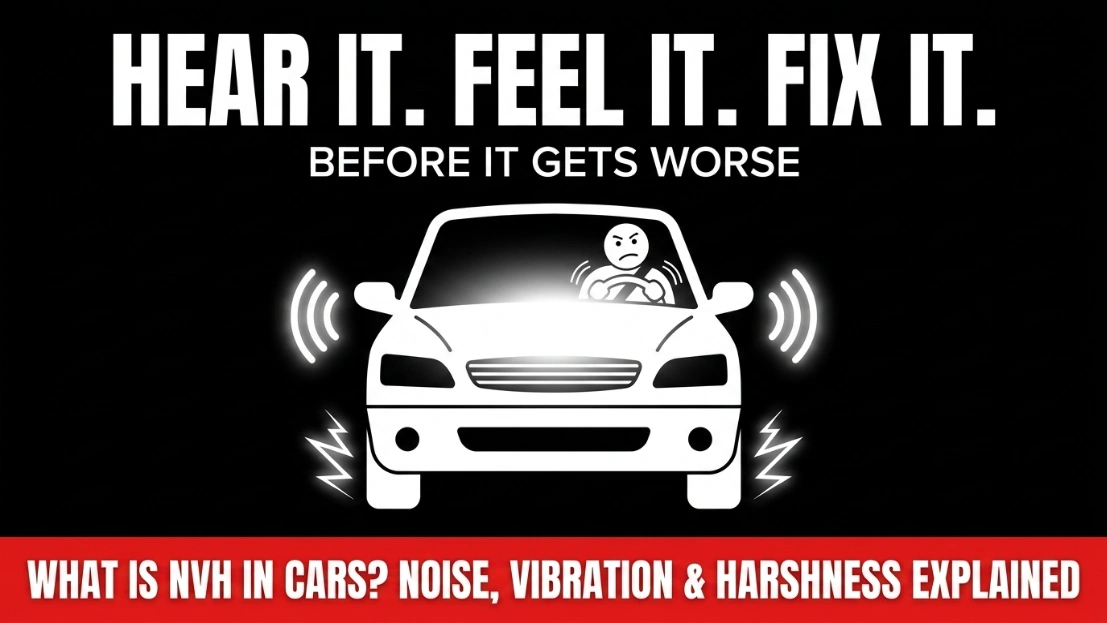
If you have ever stepped into a well-made car and noticed how quiet and composed it feels, you have experienced good NVH engineering. And if you have driven something that rattles over every bump, hums constantly on the highway, and makes the steering wheel shake at certain speeds, you have experienced bad NVH.
So what is NVH in cars, exactly? It stands for Noise, Vibration, and Harshness. It is the field of automotive engineering that decides how a car sounds and feels to the people inside it. More than most buyers realise, it shapes their impression of a vehicle before they even look at the spec sheet.
Table of Contents
What Does NVH Stand For?
NVH stands for Noise, Vibration, and Harshness. You will sometimes see it written as N&V (noise and vibration), though harshness is always part of the equation in real-world development. Each of the three components refers to something specific, and they are not interchangeable.
Noise
In automotive engineering, noise means unwanted sound inside the cabin. Engine noise, road noise, wind noise, the hiss of air past a side mirror at highway speed, the rattle of a badly fitted trim panel. Engineers classify it into two types. Airborne noise travels through the air before reaching occupants: wind turbulence, intake hiss, and exhaust sound. Structure-borne noise starts as vibration in a solid component, travels through the car’s body, and then radiates from panels, glass, or trim as audible sound. The frequency range that most affects driver perception sits between 1,000 and 5,000 Hz, though road noise lower in the spectrum is a very common complaint too.
Vibration
Vibration is what you feel rather than hear. It comes from mechanical oscillations in the engine, drivetrain, tyres, or road surface, and you sense it through the steering wheel, seat, pedals, and floor. Low-frequency vibration below about 50 Hz feels like shaking or booming. Higher-frequency vibration feels like a buzz. A steering wheel that trembles at idle or a floor that hums at a particular engine speed are both vibration problems. Engineers use mounts, bushings, and subframes to isolate vibration before it reaches the passenger compartment. The goal is not always to eliminate it; sometimes it is simply to prevent it from reaching the seat.
Harshness
Harshness is the most subjective of the three. It is not really about loudness or the measurable strength of a vibration. It is about how abruptly force is delivered to the occupant’s body. Hit a sharp pothole in a vehicle with stiff suspension, and you will understand the distinction from noise immediately. Because harshness cannot be picked up by a microphone or accelerometer in any meaningful way, automotive engineers rely on test drivers who score how particular road surfaces, bumps, and manoeuvres feel from the seat. Two experienced drivers sometimes disagree. That is what makes this part of the job hard in ways that the other two components are not.
What Causes NVH in Cars?
To understand what is NVH in cars at a practical level, it helps to know where the problem comes from. Every moving part in a car generates some noise or vibration, and the challenge is stopping those disturbances from reaching the people inside. The main sources fall into three categories.
Mechanical Sources
The engine is the most obvious one. Even well-balanced engines produce combustion pulses, valve train noise, and drivetrain vibration. At low speeds, below roughly 50 km/h, powertrain noise tends to dominate what you hear inside the cabin. Brakes generate noise through friction, which is why brake squeal is such a persistent NVH complaint during vehicle development. Tyres are a major contributor. The contact between the tyre and the road creates noise and vibration that varies by tread pattern, road surface, and speed. Suspension components transmit road irregularities directly into the body, particularly on vehicles with solid rear axles rather than independent rear suspension.
Aerodynamic Sources
Above about 100 km/h, aerodynamic noise takes over. Air flowing over the car creates turbulence wherever it meets an obstacle: side mirrors, door seals, A-pillars, and roof racks. A roof rack that sounds fine at 80 km/h can howl at 120 km/h. Engineers address this through careful body shaping, precision door and window sealing, and components that redirect airflow before it becomes audible. Nissan shaped the headlights on the Leaf partly to redirect airflow past the wing mirror housing. Small changes in body design have a bigger effect on wind noise than most people expect.
Electrical Sources
Electrical NVH is less dramatic but increasingly relevant. Alternators, power inverters, electric motors, and driver alert systems all produce noise and vibration. Electrical NVH often shows up as a whining or humming sound, usually higher-pitched than mechanical noise. In petrol cars, it was largely masked by engine sound. In electric vehicles, it is often the most prominent noise the car makes.
Why NVH Matters More Than Most People Think
NVH is not just a comfort issue. It affects how buyers read a car’s quality, how fatigued a driver gets over a long journey, and even how early a mechanical problem gets noticed.
Perceived quality is where NVH earns its reputation in the luxury segment. Buyers on a test drive respond strongly to how quiet and composed a car feels, using words like “solid” or “refined” without knowing the technical term behind what they are sensing. Excess rattling, road noise, or a boomy exhaust note reads as cheapness, regardless of the engineering underneath.
Fatigue is real, too. Road noise and vibration are physically wearing over several hours. Drivers who spend long hours behind the wheel notice this in ways that people doing short urban commutes often do not.
And there is a practical diagnostic side to it. When a car’s baseline NVH is well-controlled, unusual new noises and vibrations are easier to catch early. A new suspension clunk or an emerging rattle is hard to notice when everything already sounds chaotic. Keeping NVH low makes the car easier to maintain, not just more pleasant to drive.
NVH in Electric Vehicles: A Different Problem
The rise of electric vehicles has changed NVH engineering considerably. Remove the combustion engine, and you remove the loudest single noise source in the car. That sounds like an improvement for NVH, and in some ways it is. But it also exposes every other noise source that the engine used to cover up.
Tyre noise becomes the dominant sound in most EVs at moderate speeds. The heavy battery packs in most electric cars add weight that increases the load on tyres and produces more road noise. Motor whine, the high-frequency sound from the electric motor and inverter, becomes clearly audible in ways it never would have been in a petrol car. Wind noise at higher speeds is more noticeable because there is less powertrain sound competing with it.
Engineers working on EV NVH have to rethink the cabin acoustic budget essentially from scratch. The target is not the same as a petrol car, and in some respects, it is harder to achieve because there is less ambient noise to cover the smaller problems.
How NVH Is Measured and Tested
Testing NVH involves both objective measurement and subjective assessment. You need both because neither gives the complete picture on its own.
On the objective side, engineers use microphones and sound level meters to record noise inside and outside the cabin at different speeds and conditions. Accelerometers measure vibration in specific components. Data acquisition systems capture everything in real time, and FFT spectrum analysers break recordings down by frequency so engineers can identify exactly where a problem originates. Many development facilities have semi-anechoic chambers, rooms lined with sound-absorbing material that eliminate reflected noise and let engineers isolate only what the car itself is producing.
On the subjective side, experienced test drivers run standard routes and score the feel and sound of the car against defined criteria. Harshness always requires this kind of human evaluation. Two cars with identical accelerometer data can feel quite different to the person sitting in the seat, and it is that person’s impression that matters commercially.
How to Reduce NVH in Your Car
Whether you are an automaker or someone living with a noisy daily driver, reducing NVH comes down to three principles: cut noise and vibration at the source, interrupt the path it travels through the car’s structure, and absorb whatever gets through anyway.
Sound Deadening and Insulation
This is the most accessible option for car owners. Mass-loaded vinyl, acoustic foam, and spray-on insulation added to the floor, doors, and firewall reduce how much road and wind noise enters the cabin. Worn door and window gaskets are worth replacing; gaps in the sealing are a common source of wind noise that gets progressively worse with age. The materials are not expensive, and fitting them is manageable for anyone comfortable doing basic interior work.
Suspension and Bushing Upgrades
Rubber and polyurethane bushings absorb vibration that metal-to-metal contact would otherwise transmit directly into the chassis. Steering dampers reduce vibration coming through the steering column from uneven road surfaces. Independent rear suspension isolates the wheels from each other and from the chassis more effectively than a solid axle does, which reduces both road noise and the vibration felt through the seat.
Tyre Selection
Tyres make a bigger difference to road noise than most people expect. Tread pattern design directly affects the sound the tyre produces at the contact patch. Many manufacturers now produce EV-compatible tyres with reinforced sidewalls and quieter tread designs to compensate for battery weight. If your car is particularly loud on certain surfaces, changing tyres is often the most cost-effective place to start.
Aerodynamic Changes
Removing a roof rack reduces wind turbulence at speed. Lowering the car slightly can improve airflow around the body. On trucks, fitting a tonneau cover over the bed cuts the aerodynamic noise that open beds produce at motorway speeds. These are not expensive changes, and aerodynamic wind noise is one of the more approachable NVH problems to address without specialist help.
NVH and Car Modifications: What Enthusiasts Should Know
If you modify your car, you will probably change its NVH whether you mean to or not. A cat-back exhaust that improves flow and adds sound also increases cabin noise, often including a low-frequency drone at certain engine speeds that becomes wearing on long motorway runs. A stiffer suspension that improves handling transmits more road surface to the occupants. Wide performance tyres with aggressive tread patterns are among the noisiest modifications you can make.
None of this is a reason not to modify your car. But the trade-offs are worth thinking about before you commit. Some modifications are reversible; others lock you into a character that felt exciting on a short drive but becomes tiring after 500 kilometres. Many experienced enthusiasts take a selective approach: stiffer suspension combined with better cabin insulation, or a louder exhaust paired with improved door seals. Balancing performance character with daily comfort is possible, but it takes deliberate choices rather than just bolting things on.
Conclusion
What is NVH in cars? At its most basic, it is the gap between a car that feels well-made and one that just feels loud and tired. Noise, Vibration, and Harshness cover everything from the sounds you hear to the shocks you feel, and together they account for much of the driving experience that buyers actually remember after returning from a test drive. Good NVH takes significant engineering investment to achieve, which is why it costs more in the cars that do it well. For everyday drivers, the basics are practical and accessible: keep your tyres in good shape, replace worn seals before they let wind noise in, and think carefully about any modification that trades cabin comfort for performance gains. A quieter car is a less tiring car, and that matters on every drive, not just the first one.
Also Read: How to Check Car Battery Health: 5 Methods Every Driver Should Know
FAQs on What Is NVH in Cars
What does NVH stand for in cars?
NVH stands for Noise, Vibration, and Harshness. It refers to the unwanted sounds and physical sensations that occupants experience while driving.
Is NVH the same as road noise?
No. Road noise is one source of NVH, but the term also covers engine noise, wind noise, drivetrain vibration, suspension harshness, and the subjective feel of jolts and shocks from the road.
Why do luxury cars have better NVH than budget cars?
Mostly because of cost. Effective NVH reduction requires more insulation material, tighter manufacturing tolerances, better quality seals, and often more sophisticated suspension designs. Luxury manufacturers also spend more development time and budget specifically on NVH engineering.
Does NVH get worse as a car ages?
Generally yes. Rubber bushings and door seals deteriorate over time, and components that were tightly fitted from the factory gradually develop small amounts of play that produce rattles and squeaks. Regular maintenance slows this down, but cannot stop it entirely.
How does NVH differ in EVs versus petrol cars?
Petrol cars have a loud, constant engine noise that masks many smaller NVH sources. EVs are quieter overall, but this makes tyre noise, wind noise, and motor whine far more noticeable. EV NVH engineering has to attend to details that a petrol car can simply drown out.
Can I improve NVH myself, or do I need a mechanic?
Many NVH improvements are DIY-friendly: sound deadening materials, tyre swaps, and worn gasket replacement are all within reach for most car owners. Suspension and bushing work is more involved and may call for a mechanic, but it is still common work at any competent workshop.
Why is NVH important during a test drive?
Because it is one of the most honest signals of how a car was built. Showroom photos and spec sheets do not tell you whether a car feels composed or hollow on real roads. The test drive does, and what is NVH in cars if not the thing you actually notice for the rest of your ownership.