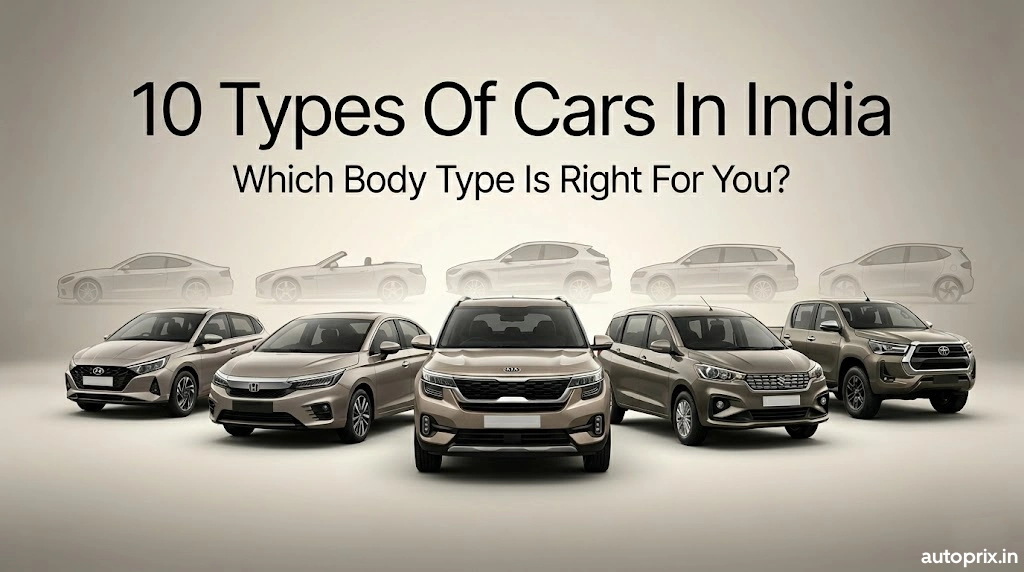
Walk into any car showroom in India today, and you will see an absurd number of options. Tall SUVs next to tiny hatchbacks. Sedans that look like they belong on a highway in Germany. MPVs designed to haul your entire extended family to Tirupati. And somewhere in the corner, a pickup truck that nobody quite knows what to do with.
The Indian car market has exploded in the last decade, and all that variety can feel genuinely overwhelming when you are spending your hard-earned money. The body type you pick affects everything: how the car handles in Bangalore traffic, whether your luggage fits for that Goa road trip, how much you spend on fuel every month, and, honestly, how you feel behind the wheel.
This guide breaks down every car body type available in India right now, along with who each one is actually built for. I have also thrown in a section on car segments (the A-to-D system that carmakers use behind the scenes) and a simple framework for making up your mind. Let’s get into it.
1. Hatchback
The hatchback is where most Indian car buyers start, and for good reason. It is a compact, two-box design where the passenger cabin and cargo area share the same space, accessed through a rear door (the “hatch”) that swings upward. There is no separate boot compartment like you would find on a sedan.
Most hatchbacks in India measure under 4 metres in length, which matters a lot more than you might think. The Indian government taxes cars under 4 metres at a lower GST rate, so manufacturers actively design hatchbacks to stay under that mark. The result: lower sticker prices and lower running costs passed on to you.
Engine sizes typically range from 0.8 to 1.5 litres. Fuel efficiency is the strongest suit of this segment, with many models delivering 20+ km/l in real-world driving. Seating capacity is technically five, but four adults is the honest comfort limit.
Popular hatchback models in India (2026)
| Model | Starting price (approx.) |
|---|---|
| Maruti Suzuki Alto K10 | ₹3.99 lakh |
| Maruti Suzuki Swift | ₹6.49 lakh |
| Tata Altroz | ₹6.65 lakh |
| Hyundai i20 | ₹7.04 lakh |
| Maruti Suzuki Baleno | ₹6.61 lakh |
Prices are ex-showroom and may vary by city.
Who should buy a hatchback?
If you mostly drive within a city, deal with narrow lanes and tight parking spots, and want a car that is easy on your wallet at the fuel pump, a hatchback is the natural fit. It is also a solid choice if you are buying your first car and want something manageable rather than intimidating.
The trade-off is space. Long highway trips with four adults and luggage will feel cramped, and there is no getting around that.
2. Sedan
A sedan stretches the body into a three-box design: one box for the engine, one for the passenger cabin, and a third for a separate, enclosed boot. That separated boot is the defining feature. When you open a sedan’s trunk, you are opening only the trunk, not the entire rear of the car.
Sedans in India range from compact models under 4 metres (the Maruti Dzire, for instance) to full-size luxury sedans well over 5 metres (think Mercedes E-Class). The extra length translates to more legroom, especially in the back seat, and a noticeably smoother ride on highways compared to hatchbacks.
Engines start at around 1.0 litre for compact sedans and go up significantly for the premium models. The ride quality is generally better because the longer wheelbase absorbs bumps more effectively.
Sedan sub-segments: compact, mid-size, executive, and luxury
India’s sedan market breaks down into four rough tiers:
Compact sedans (under 4 metres) sit at the affordable end. The Maruti Dzire and Honda Amaze live here. They benefit from the same sub-4-metre tax advantage as hatchbacks, keeping prices competitive.
Mid-size sedans (4.0 to 4.6 metres) include cars like the Honda City and Hyundai Verna. These offer a meaningful step up in rear seat space, features, and engine performance.
Executive sedans like the Skoda Octavia target buyers who want near-luxury build quality without the badge premium.
Luxury sedans from Mercedes-Benz, BMW, and Audi are 5-metre-plus cars built purely for comfort and status. Prices start north of ₹40 lakh and climb fast.
Popular sedan models in India (2026)
| Model | Starting price (approx.) |
|---|---|
| Maruti Suzuki Dzire | ₹6.79 lakh |
| Honda Amaze | ₹8.00 lakh |
| Hyundai Verna | ₹10.96 lakh |
| Honda City | ₹12.07 lakh |
| Skoda Slavia | ₹10.69 lakh |
Who should buy a sedan?
Sedans work well if you regularly drive on highways, want a comfortable back seat for passengers, and need a proper boot for luggage. They are also the default choice for professionals who want a more refined look than a hatchback but do not want the bulk of an SUV.
The downside: ground clearance is usually low (around 165 mm or less), so speed bumps and flooded roads can be annoying. In cities with terrible road surfaces, this is worth thinking about seriously.
3. SUV (Sports Utility Vehicle)
SUVs have taken over the Indian market in a way that nobody predicted ten years ago. Compact SUVs, mid-size SUVs, and full-size SUVs now outsell sedans by a wide margin.
The core appeal is straightforward: high ground clearance (typically 180-225 mm), a tall seating position that gives you a better view of the road, and a body that can handle rough terrain, potholes, and unpaved roads better than a low-slung sedan. Most SUVs also have a larger, boxier cabin, so there is more headroom and a sense of spaciousness that buyers love.
Compact SUVs vs mid-size SUVs vs full-size SUVs
This distinction matters because the price, size, and capability gaps between them are huge.
Compact SUVs (under 4 metres) are the most popular segment in India right now. Cars like the Tata Nexon, Maruti Brezza, and Hyundai Venue sit here. They offer SUV styling and a higher ride height at prices competitive with premium hatchbacks. They benefit from the sub-4-metre tax advantage, too. Off-road capability is limited, but for city driving with the occasional bad road, they are more than enough.
Mid-size SUVs (4.3 to 4.6 metres) are where the market gets interesting. The Hyundai Creta, Kia Seltos, Tata Harrier, and Mahindra XUV700 all sit here. These cars offer genuinely spacious cabins, larger engines, more features, and better highway stability. Some, like the XUV700 and Tata Safari, seat seven.
Full-size SUVs (over 4.7 metres) include the Toyota Fortuner, MG Gloster, and Jeep Meridian. These are proper body-on-frame trucks in some cases, built for heavy-duty off-roading and towing. They are expensive to buy and expensive to run, but nothing else matches them for outright capability on rough terrain.
Popular SUV models in India (2026)
| Model | Segment | Starting price (approx.) |
|---|---|---|
| Tata Nexon | Compact | ₹8.00 lakh |
| Maruti Brezza | Compact | ₹8.34 lakh |
| Hyundai Creta | Mid-size | ₹11.00 lakh |
| Kia Seltos | Mid-size | ₹10.90 lakh |
| Mahindra XUV700 | Mid-size | ₹13.99 lakh |
| Toyota Fortuner | Full-size | ₹33.43 lakh |
Who should buy an SUV?
If you live in an area with poor roads, frequently drive on highways, need a higher seating position (especially useful if you are stuck in traffic a lot), or simply want a car that feels commanding on the road, an SUV makes sense.
The compact SUV segment specifically makes sense for buyers who want that SUV look and ride height but do not want to pay or park like a full-size vehicle. I would honestly say this is the sweet spot for most Indian buyers right now.
The catch: fuel efficiency is lower than hatchbacks and sedans because these cars are heavier. Full-size SUVs especially can be painful at the pump.
4. MUV / MPV (Multi Utility Vehicle / Multi Purpose Vehicle)
MUV and MPV are essentially two names for the same thing in the Indian market. These are cars built primarily to carry people, lots of them. Seating capacity ranges from 7 to 9 passengers, arranged in two or three rows.
The Toyota Innova (now the Innova Hycross) has defined this segment in India for over two decades. It is the car that every family considers for long trips, and every tourist operator runs as a commercial vehicle. That tells you a lot about what MUVs are designed for: reliable, comfortable, high-capacity transport.
Unlike SUVs, MUVs do not pretend to be off-roaders. Ground clearance is moderate, and the focus is entirely on interior space and ride comfort. The latest MUVs come with features like captain seats in the second row, rear air-con vents, and dedicated entertainment screens, making them comfortable enough for 8-hour drives.
Popular MUV/MPV models in India (2026)
| Model | Starting price (approx.) |
|---|---|
| Maruti Suzuki Ertiga | ₹8.69 lakh |
| Kia Carens | ₹10.52 lakh |
| Toyota Innova Hycross | ₹19.77 lakh |
| Mahindra Marazzo | ₹13.18 lakh |
Who should buy an MUV?
Large families. That is the simple answer. If you regularly need to seat six or more people, an MUV does the job better than anything else. They are also a practical choice for intercity travel, commercial taxi/tourism use, and anyone who values cabin space above all else.
The trade-off is that MUVs are not particularly exciting to drive. They are built for utility, and they feel like it. If driving engagement matters to you, look elsewhere.
5. Coupe
A coupe is a two-door car with a fixed roof, designed for style and performance above practicality. The roofline usually slopes down sharply toward the rear, giving the car a sporty, aggressive profile. Seating is limited to two or four people, and rear seat space (if it exists) is typically tight enough that adults will complain.
I should be upfront here: coupes are rare in India. The road conditions do not suit them (low ground clearance plus speed bumps is a miserable combination), they are expensive, and the limited seating makes them impractical for most Indian families. But they exist, and some people buy them specifically because they are impractical. That is part of the appeal.
Popular coupe models in India
The BMW 2 Series Gran Coupe (which is technically a four-door, stretching the “coupe” definition) starts around ₹40 lakh. The Mercedes-AMG GT and Audi RS5 Sportback sit in the ₹1 crore-plus range. These are niche cars for enthusiasts with deep pockets.
6. Convertible
Convertibles have a roof that can be folded down or removed entirely, letting you drive in the open air. Modern convertibles use electrically operated metal or fabric roofs that fold at the push of a button.
Convertibles make even less sense in India than coupes, if I am being honest. The heat, dust, rain, and pollution in most Indian cities make open-top driving uncomfortable for 10 months of the year. Add in the low ground clearance and two-seat configurations, and you have a car that is basically a weekend toy for coastal drives and hill station trips.
Popular convertible models in India
The BMW Z4 (starting around ₹70 lakh) and Mini Cooper Convertible (around ₹40 lakh) are the most commonly seen convertibles on Indian roads. “Commonly” is doing heavy lifting in that sentence, because you could go months without spotting one.
7. Pickup truck
Pickup trucks have an enclosed cabin for passengers and an open cargo bed at the rear. The body is usually a body-on-frame construction (as opposed to the monocoque design used by most cars), which gives them the structural strength to carry heavy loads and handle rough terrain.
In India, pickup trucks sit at the intersection of commercial and personal use. Farmers, business owners, and adventure enthusiasts all find value in them. The open bed can carry tools, equipment, luggage, or camping gear that would never fit inside a regular car.
Popular pickup trucks in India
| Model | Starting price (approx.) |
|---|---|
| Toyota Hilux | ₹30.40 lakh |
| Isuzu D-Max V-Cross | ₹20.00 lakh |
Pickup trucks are not a high-volume segment in India, but they have a loyal following among buyers who need that combination of hauling capability and off-road strength.
8. Crossover
This is a segment that most competitor guides skip, but it has become one of the fastest-growing categories in the Indian market. A crossover blends a hatchback’s compact dimensions and car-like driving feel with an SUV’s higher ride height and chunkier styling.
The technical difference between a crossover and a “real” SUV is the platform. Crossovers are built on monocoque (unibody) car platforms, while traditional SUVs often use body-on-frame construction. In practice, this means crossovers are lighter, more fuel efficient, and easier to drive in the city, but they lack the heavy-duty off-road capability of a true SUV.
The Tata Punch is probably the best example in India. It looks like an SUV, sits higher than a hatchback, handles city roads with ease, and costs less than ₹6 lakh to start. The Citroen C3 and Maruti Fronx follow a similar formula.
Who should buy a crossover?
If you like the idea of an SUV but do not actually need one, a crossover is the honest answer. You get the raised seating position, the rugged styling, and better ground clearance than a hatchback, without the fuel penalty and parking headaches of a full SUV.
9. Station wagon
Wagons are not dead in India. But they are close. A station wagon takes the basic sedan shape and extends the roofline all the way to the rear, creating a much larger cargo area behind the second row. Think of it as a hatchback that kept growing and forgot to stop.
The Maruti Suzuki XL6 blurs the line between wagon and MPV. Historically, cars like the Fiat Weekend and Tata Estate occupied this space. In Europe, wagons from Volvo and Skoda sell like hot samosas. In India? Buyers have consistently picked SUVs and MPVs instead.
If you want sedan-like driving with significantly more cargo space, a wagon is technically the most efficient body type for that job. Good luck finding one in a showroom, though.
10. Electric cars: a new way to classify
Electric cars are not a body type in the traditional sense. An EV can be a hatchback (Tata Tiago EV), a compact SUV (Tata Nexon EV, MG ZS EV), a sedan (BYD Seal), or even a luxury SUV (BMW iX). The electric drivetrain sits underneath any body shape.
But I am including EVs here because fuel type has become a real classification layer for Indian buyers. When someone walks into a showroom today, the first question is often “petrol, diesel, or electric?” before they even get to body type. And that question affects everything from running costs to driving range to resale value.
A few things worth knowing about EVs in India right now:
Running costs are dramatically lower. Charging an EV costs roughly ₹1-1.5 per kilometre, compared to ₹5-8 per km for a petrol car. That difference adds up fast if you drive 50+ km daily.
Range anxiety is real but shrinking. Most EVs sold in India today offer 250-400 km on a full charge, which covers daily commuting easily. Long highway trips still need planning around charging infrastructure, which is improving but not yet reliable on smaller routes.
The government offers subsidies and lower GST rates on EVs, which partially offsets the higher upfront cost. The gap between EV and petrol prices has been narrowing every year.
Popular electric car models in India (2026)
| Model | Body type | Starting price (approx.) |
|---|---|---|
| Tata Tiago EV | Hatchback | ₹7.99 lakh |
| Tata Nexon EV | Compact SUV | ₹14.49 lakh |
| MG ZS EV | SUV | ₹18.98 lakh |
| Mahindra XEV 9e | SUV Coupe | ₹21.90 lakh |
| BYD Seal | Sedan | ₹41.00 lakh |
Car segments in India: the A-to-D classification
Body type tells you the shape of a car. Segments tell you its size, price bracket, and feature level. Indian carmakers and the government use an alphabetical classification system that runs from A-segment (the smallest) to D-segment and above (the largest and most expensive).
This matters because of taxation. Cars under 4 metres with engines under 1.2 litres (petrol) or 1.5 litres (diesel) qualify for lower GST rates. This tax structure has shaped the entire Indian car market, which is why so many popular models are designed to sit just under 4 metres.
Here is the breakdown:
A-segment cars are the most affordable and compact. The Maruti Alto K10 and Renault Kwid live here. These are basic city cars with small engines, minimal features, and the lowest running costs. Best for first-time buyers and budget-conscious commuters.
B-segment covers premium hatchbacks and compact sedans. The Maruti Swift, Hyundai Grand i10 Nios, and Tata Altroz sit in this bracket. More features, better build quality, and slightly more space than A-segment cars.
B2-segment is where compact SUVs live, and it is one of the hottest segments in India. Cars like the Tata Nexon, Hyundai Venue, and Maruti Brezza offer SUV styling at near-hatchback prices. This segment did not really exist a decade ago, and now it accounts for a massive share of total car sales.
C-segment includes mid-size sedans and SUVs. The Hyundai Creta, Kia Seltos, Honda City, and Skoda Kushaq are C-segment cars. Expect better ride quality, more powerful engines, and a noticeably more premium cabin.
D-segment and above is premium territory. The Toyota Fortuner, BMW X1, Mercedes C-Class, and similar cars fall here. Prices cross ₹30 lakh and climb into crores. Build quality, technology, and comfort are top-tier.
How segments affect pricing
As you move up the segment ladder, cars get bigger, heavier, and more feature-rich. Larger bodies need more sheet metal and stronger suspensions. Higher segments get turbocharged engines, automatic gearboxes, advanced safety features, and premium interior materials. All of that costs more to manufacture, which is reflected in the price.
The jump from B-segment to B2/C-segment is where most Indian buyers make their biggest decision. A well-loaded B-segment hatchback might cost ₹10 lakh, while a base C-segment SUV starts at ₹11-12 lakh. For just ₹1-2 lakh more, you get a significantly bigger car with a completely different road presence. That value equation is why compact SUVs have eaten into hatchback and sedan sales so aggressively.
How to choose the right car body type
All these body types and segments can blur together, so here is a simple decision framework based on how you actually use your car.
Start with how you actually drive. If your daily commute is under 30 km within the city, a hatchback or crossover keeps things simple and cheap. Longer highway commutes (50+ km daily) are where sedans and compact SUVs earn their keep with better seats and less road noise.
Family size matters more than most people admit upfront. A household of 5-6 people will be cramped in a hatchback on anything longer than a grocery run. Mid-size SUVs and MUVs are built for exactly this scenario. If you have a larger joint family or regularly need 7+ seats, an MUV is really the only body type that handles it well.
Road conditions should also be factored in. If you routinely drive on broken, unpaved roads, an SUV with 190mm+ ground clearance will save you from a lot of scraping and bouncing. If you also need to carry cargo, pickup trucks combine hauling space with off-road strength.
And if running costs are your top priority above everything else, a petrol hatchback is good, but an electric hatchback like the Tata Tiago EV costs a fraction per kilometre. Nothing else comes close.
Quick comparison: all car body types at a glance
| Body type | Seating | Ground clearance | Best for | Price range (approx.) | City driving with an SUV feels |
|---|---|---|---|---|---|
| Hatchback | 4-5 | 150-170 mm | City driving, first car | ₹4-10 lakh | High |
| Sedan | 5 | 150-170 mm | Highway comfort, professionals | ₹6-50+ lakh | Medium-High |
| Compact SUV | 5 | 190-210 mm | Mixed city/highway, young families | ₹8-18 lakh | Medium |
| Mid-size SUV | 5-7 | 190-220 mm | Families, long trips, rough roads | ₹11-25 lakh | Medium |
| Full-size SUV | 7 | 200-225 mm | Off-roading, towing, large families | ₹30-60+ lakh | Low |
| MUV/MPV | 7-9 | 170-190 mm | Large families, commercial use | ₹9-25 lakh | Medium |
| Coupe | 2-4 | 120-150 mm | Enthusiasts, style | ₹40 lakh-2 crore+ | Low-Medium |
| Convertible | 2 | 120-140 mm | Leisure, weekends | ₹40-80+ lakh | Low-Medium |
| Pickup truck | 4-5 | 210-230 mm | Cargo, off-road, adventure | ₹20-35 lakh | Low |
| Crossover | 5 | 180-200 mm | City driving with SUV feel | ₹6-15 lakh | Medium-High |
Wrapping up
There is no universally “best” car body type. There is one that fits your life. Your commute, your family size, your roads, your budget. That is it. Ignore what is trending on Instagram or what your colleague just bought. A hatchback that gets you to work comfortably every day is a better car for you than an SUV that sits in traffic, burning twice the fuel.
If you are actively car shopping, start with those four variables (commute, family, roads, budget), match them to the comparison table above, and you will have your shortlist down to two or three body types in about five minutes.
FAQs on Types of Cars in India
How many types of cars are there in India?
Most sources count 7 main body types: hatchback, sedan, SUV, MUV/MPV, coupe, convertible, and pickup truck. But crossovers and station wagons push the real count higher. If you include EVs as a separate category (which buyers increasingly do), the answer gets more complicated.
What is the difference between an SUV and an MUV?
SUVs are built for ground clearance, off-road capability, and a commanding road presence. MUVs are built for maximum passenger capacity and interior comfort. An SUV handles rough terrain better; an MUV fits more people more comfortably. Many modern SUVs blur this line by offering third-row seating, but the underlying design priorities remain different.
Which car body type is best for Indian roads?
It depends on where you drive. In cities with congested streets and tight parking, hatchbacks and compact SUVs are the easiest to live with. On highways and well-maintained roads, sedans offer the most comfortable ride. For broken rural roads, villages, and hilly terrain, SUVs with high ground clearance (190mm+) handle things better than anything else.
What is the most popular car type in India right now?
SUVs. It is not even close anymore. Compact SUVs specifically have overtaken hatchbacks in monthly sales volumes, with the Tata Nexon, Hyundai Creta, and Maruti Brezza consistently sitting among India’s top-selling cars. The shift started around 2019 and accelerated through 2023. At this point, it looks permanent.
Which is the most fuel-efficient car body type?
Hatchbacks. Their lighter weight and smaller engines mean less fuel burned per kilometre. If you want the absolute lowest running costs, an electric hatchback like the Tata Tiago EV costs a fraction of what even the most efficient petrol hatchback costs per km.
What is a crossover, and how is it different from an SUV?
A crossover is built on a car platform (monocoque/unibody construction), while a traditional SUV uses body-on-frame construction. Crossovers are lighter, more fuel efficient, and handle more like a regular car. They offer a raised seating position and rugged looks but lack the structural capability for serious off-roading that body-on-frame SUVs provide.
Are electric cars a separate body type?
No. EVs are a powertrain type, not a body type. You can buy electric hatchbacks, electric SUVs, electric sedans, and even electric MPVs. The body shape is independent of what powers the car. But because the EV buying decision is so different from the petrol/diesel decision (charging infrastructure, range, subsidies), it has become a classification layer that matters as much as body type for many Indian buyers.
What does the sub-4-metre rule mean for car prices in India?
The Indian government applies lower GST rates to cars that measure under 4 metres in length and have engine capacity under 1.2 litres (petrol) or 1.5 litres (diesel). This creates a strong financial incentive for manufacturers to design cars just under the 4-metre mark. It is why so many hatchbacks, compact sedans, and compact SUVs cluster around 3.99 metres. Buyers benefit from lower on-road prices, and manufacturers benefit from higher sales volumes.