New cars in India are expensive. Waiting periods stretch for months. And then there’s road tax, insurance, and registration, all piling on top of an already steep sticker price.
It’s no wonder the used car market has grown faster than new car sales for three years straight. India now sees roughly 1.2 used cars change hands for every new car sold. That number keeps climbing.
But here’s the thing nobody tells you upfront: buying a used car involves a lot more than finding a good price on Cars24 or OLX. Get it wrong, and you could end up with a car that has an active loan on it, a chassis number that doesn’t match the RC, or a vehicle that legally still belongs to someone else.
This guide walks you through the entire process, from figuring out what you actually need to completing the RC transfer at the RTO. No fluff, no sales pitch.
Table of Contents
Why Buying a Used Car Makes Sense in 2026
Let’s get the obvious stuff out of the way before we get into the how-to.
A new car loses somewhere between 15 and 30% of its value in the first year. You buy it, drive it out of the showroom, and it’s already worth less. Used cars have already absorbed that first hit, which means you’re buying into a more stable value. If you need to sell two years later, the loss is smaller.
Other practical advantages:
- Insurance costs less. Older vehicles have a lower Insured Declared Value (IDV), so premiums are lower.
- You get more car for the money. A Rs 7 to 8 lakh budget buys a basic new hatchback or a 3-year-old mid-size sedan with features the new car doesn’t have.
- Certified platforms have reduced the risk significantly. Cars24, Spinny, and CarDekho now run 200 to 300 point inspections before listing, which wasn’t the case five years ago.
That said, used cars come with history. Sometimes that history is fine. Sometimes it isn’t. The rest of this guide is about figuring out which one you’re dealing with.
New Car vs Used Car: A Quick Comparison
| Factor | New car | Used car |
|---|---|---|
| Price | Full on-road price | 30 to 60% lower, depending on age |
| Depreciation hit | You absorb it | Mostly absorbed already |
| Warranty | Manufacturer warranty | Limited or none unless certified |
| Insurance premium | Higher IDV = higher premium | Lower IDV = lower premium |
| Risk | Minimal | Requires due diligence |
| Customization | Choose colour/variant | Buy what’s available |
Step 1: Figure Out What You Need (and what you can actually spend)

Before you open a single listing, spend 15 minutes on this.
What kind of car do you actually need? A hatchback handles city traffic better and parks more easily. A sedan gives you more boot space and highway comfort. An SUV is good if you regularly carry 5 or more people or drive on bad roads. Don’t buy an SUV because you think you might need it someday.
What fuel type makes sense? This matters more than most people think:
- Petrol: lower maintenance cost, better for city driving under 1,500 km/month
- Diesel: better fuel economy at high mileage (1,500+ km/month), but maintenance is costlier and older diesel cars face age restrictions in cities like Delhi (10-year cap)
- CNG: very cheap to run, but you give up boot space, and refuelling stations are patchy outside major cities
Now set a real budget. Not just the car price, but the total cost of owning it. Add:
- RTO ownership transfer fee: Rs 300 to 600
- Fresh insurance or insurance transfer: Rs 6,000 to 20,000+, depending on vehicle and coverage
- PUC certificate: Rs 100 to 200
- Immediate repairs or servicing, you know it needs
- Any accessories you want fitted
A car listed at Rs 4 lakh can easily cost Rs 5 to 5.5 lakh all-in. Know that before you negotiate.
One more thing: don’t tell the dealer your maximum budget. Once they know that number, every negotiation is anchored to it.
Step 2: Where to Find a Used Car in India
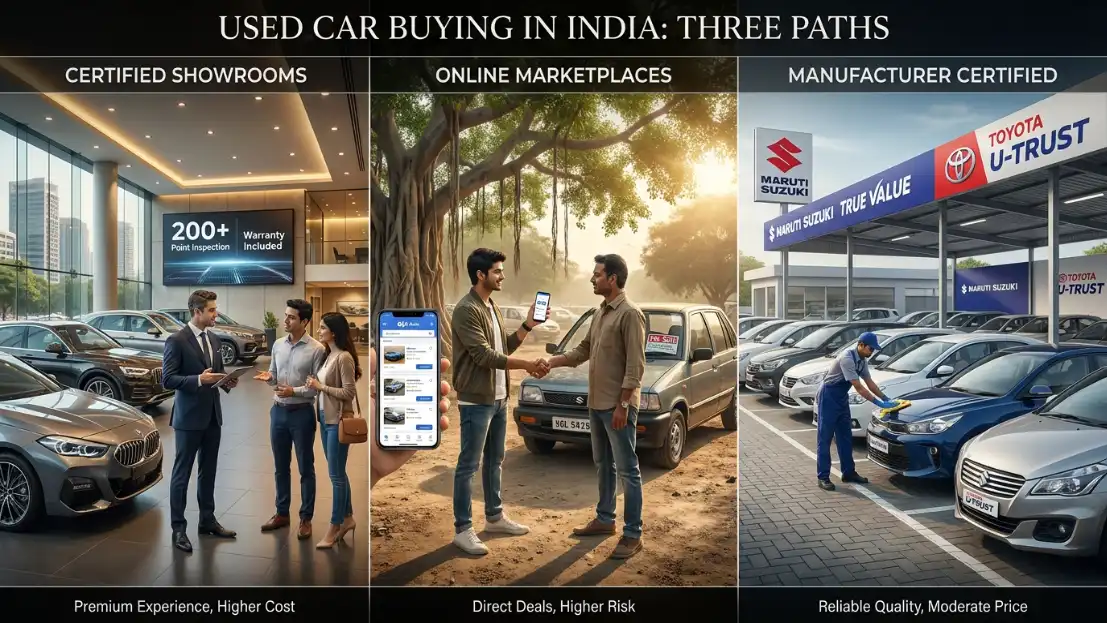
There are three main routes. Each has its own trade-offs.
Certified online platforms (Cars24, Spinny, CarDekho)
These platforms inspect every car against a 200 to 300-point checklist before listing. You get a detailed inspection report, a warranty (usually 6 months to 1 year with extended options), and they handle the RC transfer paperwork. Prices are non-negotiable or have very little room.
Good for first-time buyers, anyone who doesn’t want to deal with paperwork or mechanic inspections, and people who value peace of mind over getting the absolute lowest price.
Classified platforms (OLX, CarTrade C2C)
It deals directly with individual owners. Prices are lower, sometimes significantly. But you’re entirely on your own for inspection, document verification, and RC transfer.
The question people ask most: Is OLX safe?
It can be. But you need to treat every listing with some scepticism. Red flags to watch: seller won’t meet in person, price is 20%+ below market, they’re in a rush to sell, they can’t produce the original RC, or they want payment before you’ve seen the car.
Manufacturer certified pre-owned programs (Maruti TrueValue, Mahindra FirstChoice, Toyota U-Trust)
Authorised dealers sell these. Cars go through brand-specific inspections and often come with manufacturer-backed warranties. Prices sit between OLX and standalone certified platforms.
Good for people who want a specific brand and trust the dealership network for future servicing.
Step 3: How to Inspect a Used Car Before Buying
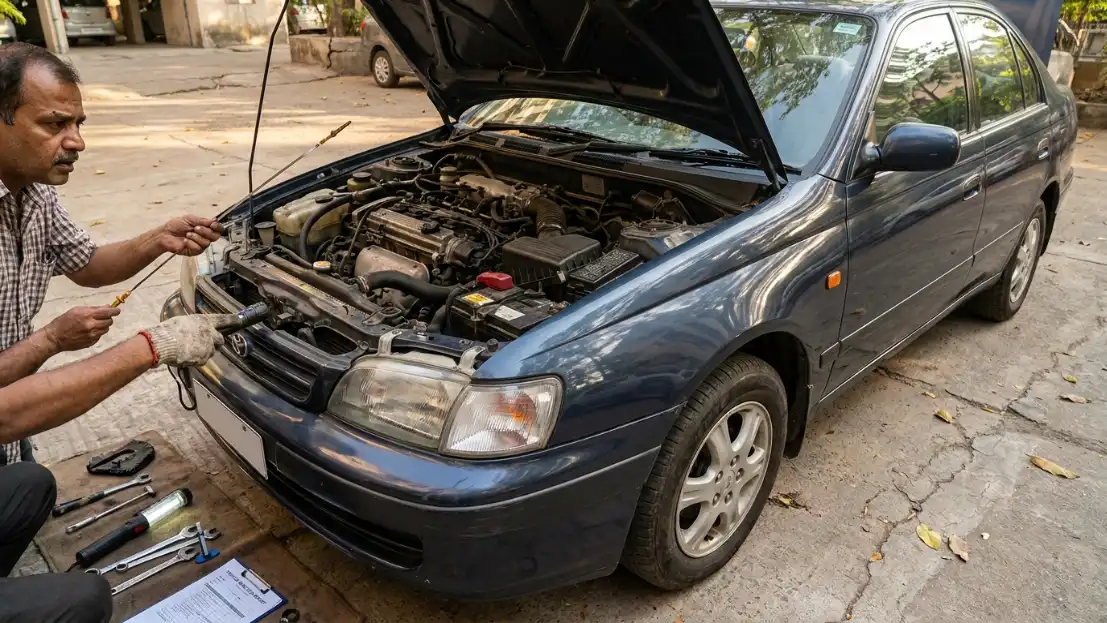
Most buyers spend more time picking a phone case than inspecting a car. Then they wonder why the AC stopped working after two weeks in.
One rule before anything else: inspect in daylight, on a dry day. Scratches and paint mismatches disappear at night and in wet conditions. If a seller insists you visit in the evening or won’t schedule a daytime meeting, that’s a tell.
Exterior
Walk around the car slowly before getting inside. Look for:
- Paint mismatch between panels. Hold your head low and look along the side panels in the light. A slightly different shade on the door compared to the fender means that the panel was repainted, which usually means it was in an accident.
- Panel gaps. Open and close each door. The gaps between panels should be consistent. Uneven gaps mean body repair or poor reassembly.
- Windshield. Check the corner for the manufacturer’s logo (Saint-Gobain, Asahi, etc.). Generic glass with no logo was replaced after an accident.
- Rust. Check under the sills, around the wheel arches, and at the bottom of the doors. Surface rust can be managed. Structural rust cannot.
- Tyres. Check tread depth on all four (a Rs 1 coin is a rough gauge: if you can see the full lettering on the edge, the tread is low). Uneven wear across one tyre usually means alignment or suspension problems.
Under the hood
Open the bonnet and look around before starting the engine:
- Engine oil: pull the dipstick, wipe it, dip again. It should sit between min and max. Dark brown or black oil that smells burnt means the owner skipped services.
- Coolant: check the reservoir level. Low coolant with no top-up container nearby is a flag.
- Look for oil stains around the engine block, hoses, or on the ground under where the car is parked.
- Find the chassis number stamped on the firewall (inside the bonnet) and match it to what’s on the RC. They must be identical.
Now start the engine cold:
- White or blue smoke from the exhaust after startup means potential engine wear.
- Knocking or ticking sounds that get louder under load is bad news.
- Let it idle for 5 minutes and recheck: any leaks, any new warning lights?
Interior
- Sit in each seat. Check for tears, staining, and sagging foam.
- Smell the car with the door closed. A mildew or musty smell signals possible water ingress or flood damage.
- Test every button: AC, power windows (all four), central locking, wipers, horn, infotainment, dashboard lights.
- Check for warning lights that stay on after the engine warms up.
Get a mechanic
If you don’t know cars well, bring someone who does. Most mechanics will do a pre-purchase inspection for Rs 500 to 1,500. It’s the best money you’ll spend in this process.
How to check the car’s history on VAHAN
Before you make any decision, open vahan.parivahan.gov.in and enter the registration number. You can verify:
- Who the registered owner is
- How many times has ownership changed
- Whether there’s an active hypothecation (loan)
- Insurance validity
- Fitness certificate and PUC status
- Pending challans (traffic fines)
This takes 2 minutes and costs nothing. There’s no excuse to skip it.
Step 4: Test Drive Checklist
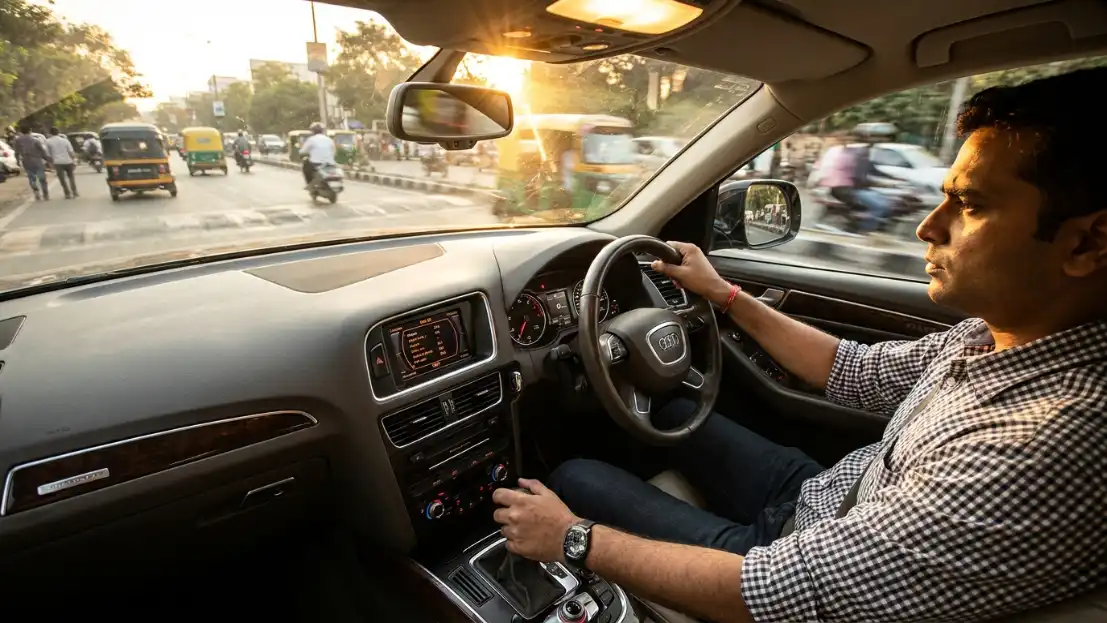
A test drive is not a formality. Drive at least 8 to 10 km on mixed roads.
Clutch: press it fully. The bite point should be in the middle range of travel. If it engages very high, near the top, the clutch is worn, and replacement isn’t cheap.
Brakes: test braking at 40 kmph and at 60 kmph. The car should stop straight without pulling to one side. Any grinding or scraping means the pads are done.
Gears: all gears should engage cleanly. Resistance, grinding, or slipping in the second (the most-used gear) is a serious concern.
Steering: hands lightly on the wheel at 60 kmph, the car should track straight without drifting. Any pulling to one side means alignment or suspension work ahead.
Suspension: drive over a speed breaker slowly. You want a controlled thud, not a metallic clunk or an after-bounce. Clunking means worn shock absorbers.
AC: run it on maximum for 10 minutes. The cabin should get cold within 3 to 4 minutes. If it takes longer or never really gets cold, the compressor or gas needs attention.
Note any rattles from the dashboard or doors. These are minor but constant irritants and usually indicate the car was put back together after a repair.
Step 5: Documents You Must Check Before Paying Anything
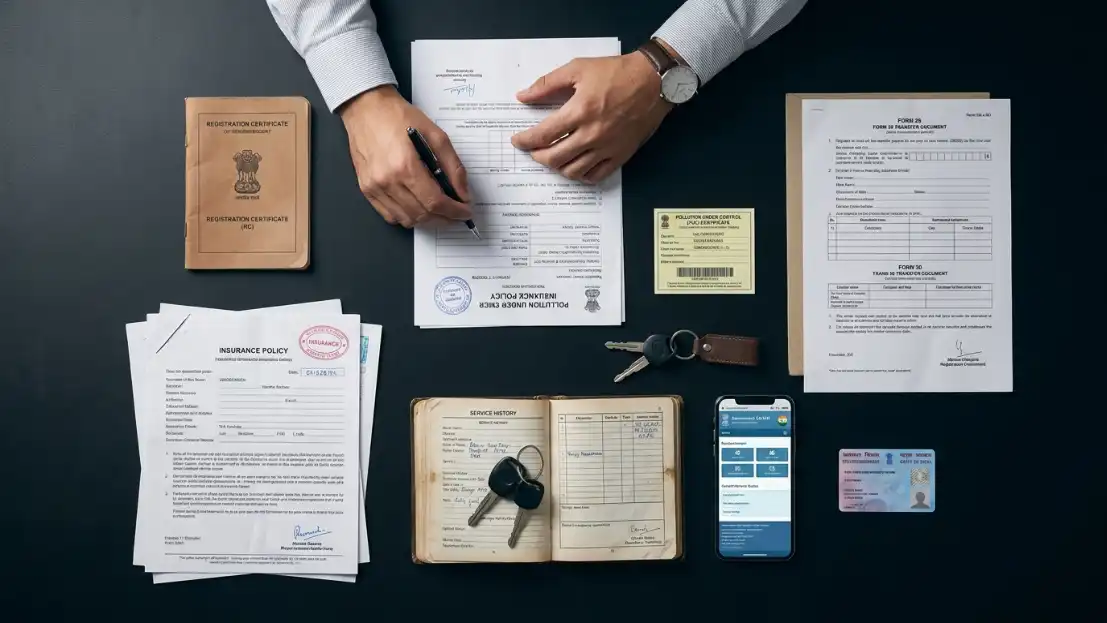
This section is the one most buyers gloss over. Don’t.
Registration Certificate (RC)
The most important document. Check that the chassis number and engine number on the RC match what’s physically on the car. The RC should be the original, not a Duplicate RC (marked “DRC”). If it’s a DRC, ask why and verify the reason. Check how many previous owners are listed and note the state it’s registered in. If it’s different from yours, you’ll need to re-register it.
Car insurance
Is it valid? Ask about claim history. Heavy past claims suggest a rough history. Check the NCB (No Claim Bonus): a clean history means a higher NCB, which can transfer to your benefit.
PUC certificate
Must be valid. Without it, you can’t transfer the RC and can be fined on the spot.
Service book / service records
Stamps from authorised service centres show the car was maintained. Gaps between services are a yellow flag. No service book at all is a red flag.
Road tax receipt
Confirms road tax was paid by the first owner. Unpaid road tax liability can pass to you.
Loan NOC (if the car was under finance)
Check the RC for any hypothecation entry. If a financier is listed, the seller must give you Form 35 (loan closure) and a No Objection Certificate from the bank before you pay. Without this, you could inherit the outstanding loan.
Forms 29 and 30
These are the mandatory transfer documents. Form 29 is the seller’s notice of transfer. Form 30 is the buyer’s application for transfer. Both get submitted to the RTO. Without them, the RC cannot be transferred to your name.
How to check if a used car has an active loan
Check the RC for a “hypothecation” entry. Use the VAHAN portal to confirm. If a lender is listed, ask for Form 35 and a written NOC before paying a rupee.
Step 6: How to Negotiate the Price

Most buyers are uncomfortable negotiating. But dealers, especially offline ones, routinely price in 10 to 15% wiggle room.
Use your inspection findings as leverage. A worn clutch isn’t just a mechanical issue; it’s a negotiating point. Pending challans on the VAHAN check? Ask for them to be cleared before the deal, or deduct the amount from the price.
Check the market value before you visit. Go to CarDekho or CarWale, search for the same make/model/year/variant in similar condition, and note the price range. Walk in knowing the number, not guessing it.
Good times to buy:
- End of the month: dealers under sales targets are more flexible
- End of financial year (February/March): inventory clearance pressure
- Post-festive season: stock is higher, sellers are more motivated
One tactic that actually works: make a reasonable offer and stay quiet. Silence is uncomfortable. Let the seller fill it.
Step 7: Financing a Used Car
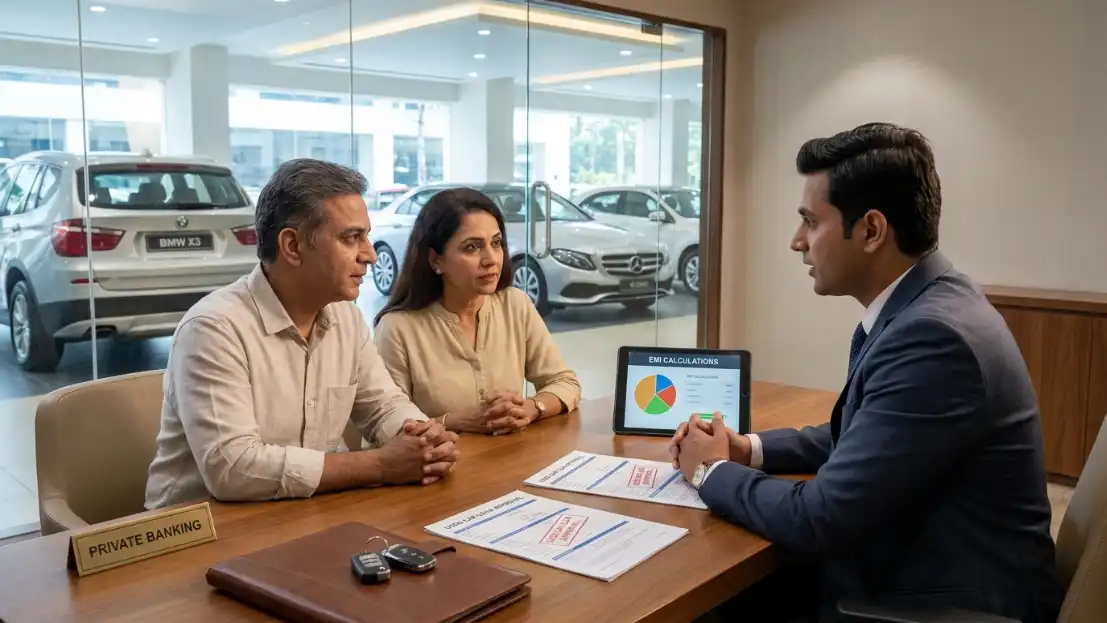
Used car loans are available from most major banks and NBFCs. In 2026, interest rates for used car loans typically run between 10 and 16% per annum, higher than new car loans because the vehicle is older and the lender’s risk is higher.
What to know before you apply:
- Most lenders finance 70 to 90% of the car’s assessed value, not the transaction price. If the bank values the car lower than what you’re paying, the gap comes from your pocket.
- Tenure can go up to 7 years. Longer tenure means lower EMI but more interest paid overall. Run the numbers.
- Dealer-arranged loans are convenient but may not be the best rate. Get a quote from your own bank first and use it as a benchmark.
- Check pre-closure terms. Some lenders charge a penalty if you repay early.
Used car loan vs personal loan
| Used car loan | Personal loan | |
|---|---|---|
| Interest rate | Yes, the bank is listed on RC | 12 to 20% |
| Loan-to-value | Up to 90% of car value | Up to full price |
| RC hypothecation | Yes, bank is listed on RC | No |
| Approval time | 1 to 3 days | Same day to 2 days |
If you don’t want the bank’s name on your RC (some people prefer this for resale reasons), a personal loan is cleaner, just more expensive.
Step 8: RC Transfer, the step most buyers delay
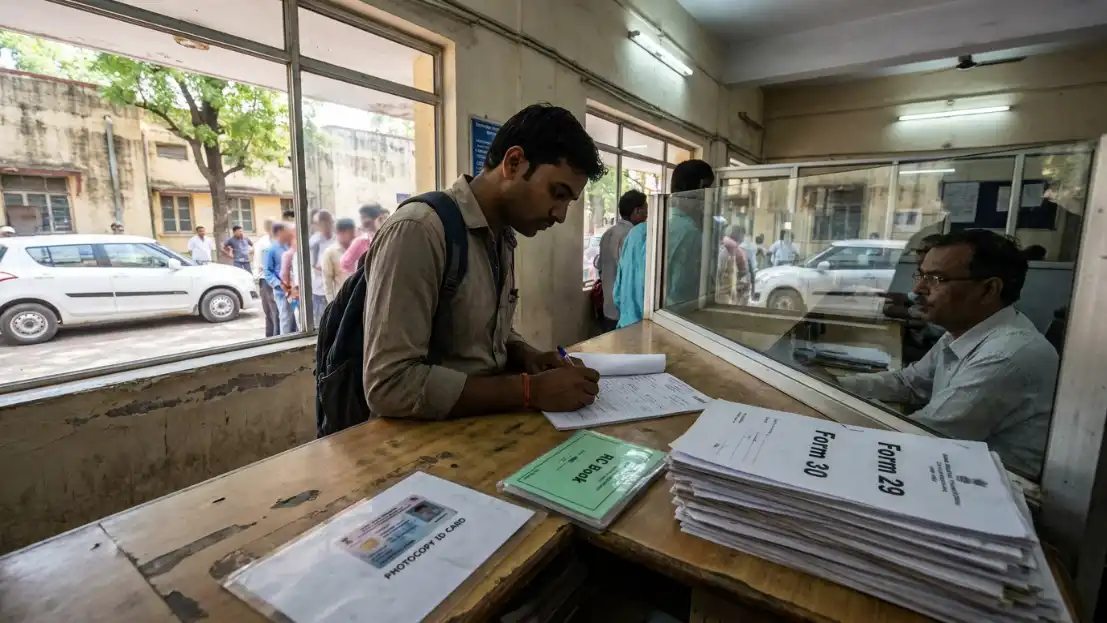
After the deal is done, the car legally still belongs to the previous owner until you complete the RC transfer. This matters for insurance claims, traffic challans, and legal liability if the car is involved in an incident before transfer.
The legal timeline:
- Seller must file Form 29 (notice of transfer) with the RTO within 14 days of the sale
- Buyer must submit Form 30 (transfer application) within 14 days if intra-state, or 45 days if inter-state
- Transfer fee: Rs 300 to 600, depending on state and vehicle type
Documents needed for RC transfer:
- Original RC
- Two copies of Form 29 (signed by seller)
- One copy of Form 30 (signed by both)
- Valid insurance certificate
- Valid PUC certificate
- PAN card or Form 60 (if transaction value exceeds Rs 50,000)
- Address proof and ID proof of the buyer
- Engine and chassis impression (taken at RTO)
- Passport-size photograph
Online or offline? Both work. The Parivahan Sewa portal (parivahan.gov.in) handles online applications for most states. You upload documents, pay the fee digitally, and the new RC arrives in 7 to 21 working days. For offline, visit the RTO with all documents and the seller (some states require the seller’s signature in person).
Inter-state transfer is more involved. You need a No Objection Certificate from the state where the car is currently registered before you can register it in your state. Plan for 4 to 6 weeks and a few extra fees.
Red Flags: When to Walk Away
Some deals aren’t worth saving. If you run into any of the following, reconsider before committing money:
- Seller refuses a mechanic inspection. There is no legitimate reason for this. Walk away.
- No original RC. Even a “it’s at home, I’ll bring it next time” should make you cautious. Don’t pay a token advance without seeing it.
- The car has an active loan with no NOC. Do not pay in full until the loan is formally closed and the NOC is in your hand.
- Price is significantly below every comparable listing. Sometimes it’s a distressed sale. More often than not, something is wrong with the car or the paperwork.
- Chassis number stamps look tampered with. Faint re-stamping, rough edges, or numbers that don’t match the RC format are signs of a potentially stolen vehicle.
- Fresh paint on specific panels only. Normally, used cars don’t get one door repainted. Targeted repainting almost always means an accident that the seller isn’t disclosing.
- Lots of pending challans. Not a dealbreaker by itself, but a sign the car wasn’t well looked after. Use it in negotiation or insist they’re cleared before you take ownership.
Conclusion
Buying a used car in India in 2026 is genuinely more manageable than it was five years ago. Certified platforms have raised the floor on quality. The VAHAN portal makes document verification a 2-minute task. RC transfer can be done online from your phone.
But it still requires you to do the work. Inspect the car in daylight. Check the chassis numbers. Run the VAHAN lookup. Read every document before you sign.
The buyers who get burned are almost always the ones who got excited and skipped a step, usually the paperwork step, because it feels boring compared to the test drive. Don’t be that person. The test drive is fun. The Rs 4 lakh mistake is not.
Also Read: 10 Types Of Cars In India: Which Body Type Is Right For You?
FAQs on How to Buy a Used Car in India
Is it safe to buy a used car from OLX in India?
It can be, but you carry all the risk yourself. Always meet in person during daylight, verify the original RC, run a VAHAN check, and bring a mechanic. Never pay any advance without signed documents.
How do I check if a used car has a loan on it?
Check the RC for a “hypothecation” entry. It will list the financier’s name if a loan is active. The VAHAN portal also shows active hypothecation. If there is one, the seller must provide Form 35 and a written NOC from the lender before you complete the purchase.
What documents are mandatory when buying a used car?
At minimum: original RC, valid insurance, valid PUC, Form 29 and Form 30, road tax receipt, and a loan NOC if the car was under finance. Service history is not mandatory but is strongly recommended.
How much does RC transfer cost in India?
Usually Rs 300 to 600, varying by state, vehicle type, and whether it’s intra-state or inter-state. Late submission can attract penalties.
Can I get a loan for a used car in India?
Yes. Banks and NBFCs offer used car loans at 10 to 16% per annum with tenures up to 7 years. Most lenders finance 70 to 90% of the car’s assessed value.
What’s the safest platform to buy from?
Certified platforms like Cars24 and Spinny carry the least risk for first-time buyers. They’re more expensive than OLX deals, but you get an inspected vehicle, a warranty, and handled paperwork. If price is the priority and you’re comfortable doing your own checks, OLX and direct-owner deals can work.
How many previous owners is acceptable?
One previous owner is ideal. Two is generally fine. Three or more raises questions. Not automatically a dealbreaker, but go in with extra scrutiny on both condition and the documentation trail.
What’s the best time of year to buy a car?
End of the month, end of the financial year (February to March), or just after the festive season (November to December). Sellers are more motivated, and there’s more inventory to choose from.